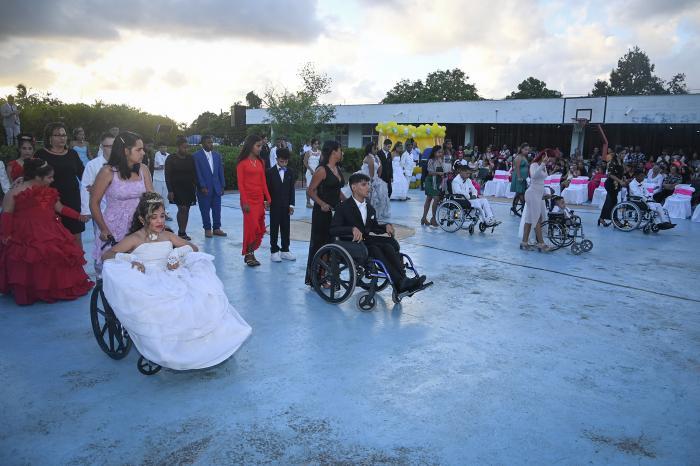
On a windy Thursday in April 2026, 19 young people gathered at Havana’s Solidaridad con Panamá School to mark a universal coming-of-age milestone: their 15th birthdays. For decades, this school has upheld a beloved tradition of celebrating quinceañeras for disabled students, a ritual that has endured through the decades of economic blockade that have shaped daily life in Cuba.
As preparations wrapped up, the first chords of the traditional quinceañera waltz rang out across the school grounds. Not every dancer moved in perfect step: some relied on canes for support, others maneuvered custom wheelchairs across the esplanade, and many leaned gently on their partners to steady their balance. But to observers in attendance, there was no mistaking the perfection of the moment—raw, genuine, and alive with the joy of the young people at the center of the celebration. Bright yellow balloons dotted the open space, holding their ground against strong gusts of wind, a quiet metaphor for the resilience of the students gathering to mark their big day. Nineteen wide smiles shone across the esplanade, none dimmed by the adversity that has tested Cuban communities for decades, each one a candle of hope that no hardship can blow out.
Cuba’s highest-ranking leaders joined the celebration: Miguel Díaz-Canel Bermúdez, First Secretary of the Central Committee of the Communist Party of Cuba and President of the Republic, and Manuel Marrero Cruz, member of the Political Bureau and Prime Minister of Cuba, were among the guests, moved by the students’ determination and joy. From the school’s esplanade, the gathered students and faculty sent warm birthday greetings to retired Cuban revolutionary leader Army General Raúl Castro Ruz, a long-time supporter of the institution’s work.
Esther María La O Ochoa, known affectionately as Teté, who served as the school’s director for many years, reflected on the legacy of the annual celebration. She credits Fidel Castro Ruz, the school’s founder and former Commander-in-Chief, and Raúl Castro Ruz, for ensuring this tradition was never interrupted, even in the hardest of times. “We live in a Cuba under blockade, but never one that refuses to give love,” she told the assembled crowd.
As the event unfolded, the colors of students’ outfits mingled across the open esplanade, with wheelchair users gathering front and center to lead the celebration. “No one could stop this celebration,” one student said—a sentiment echoed by everyone in attendance. These young people, each with their own unique body shapes and personal stories of overcoming struggle, reminded all present that every life is worthy of celebration, no matter the circumstances.
For 20 full minutes, tenderness and hope walked hand in hand across the school grounds. Glasses were raised in a toast to happiness, and shared embraces erased all lines of status, distance, and prejudice, holding space only for quiet joy. Many parents openly wept as they watched their children dance, and teachers—who have long stepped into caregiving roles for their students—shared in the profound, soft joy of the moment. At the center of it all, the 15-year-olds beamed, their smiles unclouded by hardship.
For these students, the bouquets they held were far more than decorative flowers: they were a living promise of what is still to come, a testament to the core belief that has guided the school and this tradition for more than 25 years: even amid difficulty, in Cuba, every person matters, and every life will persist in blossoming.