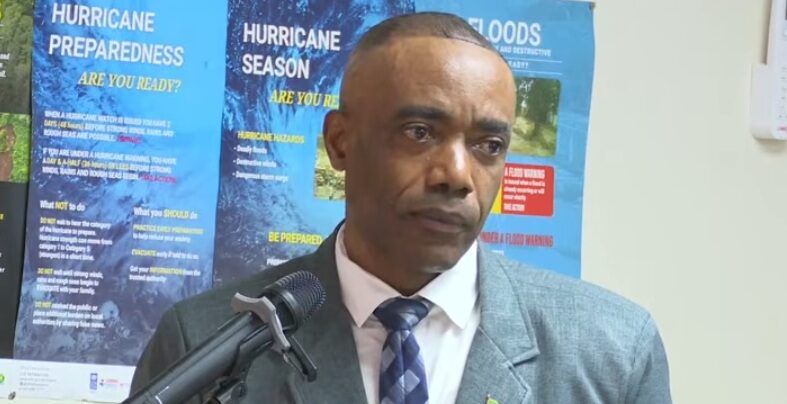
Against a backdrop of rising concern over illicit firearms trafficking and armed violence across the Caribbean, Dominica’s Minister for National Security Rayburn Blackmoore has issued a urgent call for a comprehensive, uncompromising anti-crime system to root out complicity in illegal weapons activity on the island.
Blackmoore’s remarks came during the opening of a three-day Inter-Institutional Roundtable meeting, held from April 8 to 10, 2026. The high-level gathering was jointly convened by the Government of the Commonwealth of Dominica through its Ministry of National Security and Legal Affairs, in partnership with two leading regional and global security bodies: the United Nations Regional Centre for Peace, Disarmament and Development in Latin America and the Caribbean (UNLIREC), and the CARICOM Implementation Agency for Crime and Security (CARICOM IMPACS).
The summit brings together senior decision-makers from a cross-section of critical government agencies, including portfolios focused on national security, law enforcement, judicial affairs, foreign relations, gender equity, and performance monitoring. Its core mission is to amplify national action to counter the dual crises of unregulated illegal firearms and pervasive armed violence, aligning local efforts with a broader regional commitment to safety.
As outlined in an official press statement from the Ministry of National Security, the roundtable discussions form part of Dominica’s ongoing contribution to advancing the Caribbean Firearms Roadmap, a landmark regional framework designed to crack down on illicit weapons trafficking, cut rates of violent crime, and strengthen public safety across all Caribbean nations.
In his keynote address, Blackmoore drew attention to a little-discussed enabler of persistent gun trafficking: systemic complicity. He noted that illegal firearms trade can only thrive when facilitated by bad actors, pointing out that both private and public sector insiders often profit from criminal proceeds and aid wrongdoers in evading detection.
To counter this, Blackmoore argued that any effective response must be robust and rigorous enough to identify complicit individuals and remove them from public and institutional life. He highlighted a unique challenge facing Dominica’s small, close-knit communities, where social ties often lead to quiet tolerance of criminal activity. “We live in a small society, homogeneous communities, where everybody knows each other and as a consequence, we harbor criminals,” Blackmoore said. “And if we are serious about the future of this country, all of us have that moral responsibility to do what we need to do to identify those who have made it their vocation to corrupt every institution in this country, including our young men, who have been used as mules to carry out the trade of worthless, no-face individuals.”
Blackmoore called for an end to empty finger-pointing and political posturing, urging collective accountability for addressing the crisis. “And if we are serious about the future of this country, we have a responsibility to stop the pretence and to stop pointing fingers, because when you point your finger, the thumb is back in your face,” he added.
Closing his address, Blackmoore stressed that confronting the illicit gun trade is a non-partisan issue that threatens the foundation of Dominican society. He urged all stakeholders to set aside political differences to tackle what he described as a fundamental threat to the country’s “civilization and civility.”