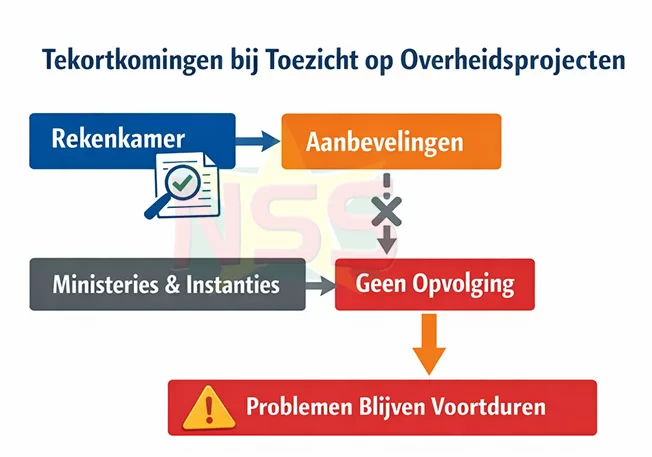
On April 8, the Netherlands Court of Audit released a damning annual audit report highlighting long-standing structural flaws in government oversight and follow-up processes that continue to erode the effectiveness of public administration across the country. The core finding of the report is that corrective recommendations issued after previous audits have rarely been fully implemented, with most either ignored entirely or only partially acted upon by responsible bodies. The audit institution found that national ministries and executive agencies consistently fail to prioritize addressing documented governance weaknesses, creating a cycle where identical problems reemerge across departments time and again. These recurring issues include incomplete financial record-keeping, unclear accountability frameworks for public spending, and inadequate oversight of major government projects. Further investigation into internal governance systems revealed that internal control mechanisms are non-functional or underperforming in multiple agencies. Project monitoring protocols are poorly designed and inconsistently enforced, while required progress and financial reports are often delayed or submitted with critical omissions. This lack of consistent, timely data prevents public officials from making necessary mid-course corrections to failing projects, and significantly increases the risk of wasteful or inefficient use of taxpayer money. One of the most critical bottlenecks identified by the Court of Audit is the limited translation of audit findings into actual policy and operational change. While auditors regularly formulate clear, actionable recommendations to address gaps, most agencies lack formal structures to implement these changes or track progress over time. Without dedicated follow-up systems, meaningful, lasting improvements to governance never materialize. This breakdown in oversight also puts increasing pressure on parliamentary checks and balances. When the executive branch fails to provide complete, timely information about public spending, lawmakers cannot effectively exercise their constitutional responsibility to oversee how state funds are allocated and used, weakening democratic accountability. The Court of Audit emphasized that urgent action is needed to strengthen internal control systems, clarify lines of accountability across all government bodies, and establish formal, systematic processes for following through on audit recommendations. Without these foundational changes, the institution warned, the risk of repeated inefficiencies and structural governance failures will remain embedded in the public administration. To break this cycle of recurring problems, the Court is calling for a fundamental shift toward a results-focused approach to public governance. Under this new framework, auditors and government bodies alike would not only identify existing weaknesses, but also be required to demonstrate tangible progress on structural improvements across the entire government apparatus.
Rekenkamer: Aanbevelingen blijven liggen, toezicht op overheidsprojecten schiet tekort