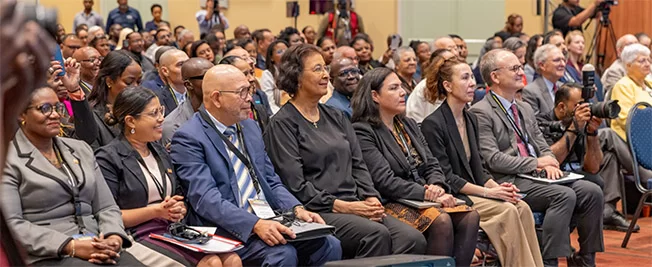
PARAMARIBO, Suriname – April 8, 2026 – Suriname is set to realign its entire education system around national production and inclusive economic growth, President Jennifer Simons announced Wednesday during the opening ceremony of the two-day 2026 Education Congress, hosted at the Royal Ballroom of Hotel Torarica. The event, carried out in partnership with the Inter-American Development Bank under the theme “Investing Today, Transforming Tomorrow”, brings together cross-sector stakeholders to map a new long-term direction for education tied to the country’s broader development goals.
Simons anchored her reform proposal in the administration’s 2025 governing agreement, which prioritizes strengthening Suriname’s productive economic sectors. She emphasized that accelerated expansion of primary, secondary, and tertiary vocational education is critical to building a more resilient national economy, noting that production-focused training will extend far beyond the country’s booming oil and gas sector to support growth across all major industries.
“National production is the foundation of food and economic self-sufficiency, and it is the bedrock of rising living standards, broad-based prosperity, and growing export volumes,” Simons told attendees. While framing education as a core driver of human well-being and economic progress, she also highlighted the indispensable role of advanced scientific education in tackling the country’s most pressing social and economic challenges. The president did not shy away from acknowledging the serious systemic challenges that currently hinder Suriname’s education sector, opening the door for candid discussion at the congress.
This 2026 kickoff event marks the first step toward a larger national education congress scheduled for later this year. The immediate goal of the opening gathering is to collect expert insights from across sectors, which will then be used to co-develop detailed policy frameworks alongside key stakeholders.
Looking ahead to the 2026-2027 academic year, Simons laid out two urgent priorities: resolving persistent bottlenecks that have disrupted learning across the country, and creating new pathways for young people who have dropped out of the formal education system to re-engage and build skills. Beyond immediate fixes, the government will also develop a comprehensive 5 to 15-year long-term vision to guide sustained reform.
The president laid out clear expectations for tangible outcomes from the congress process. Final deliverables will include an actionable action plan for addressing urgent systemic issues, a broadly supported national education vision, a clarified definition of the professional role and responsibilities of teachers, a formal framework for updated education legislation, and a sustainable long-term funding model for the sector.
A key focal point of the president’s address was the need to elevate the status of the teaching profession. Simons called for long-term reforms to ensure teachers receive compensation and professional recognition on par with other highly educated professionals. “The younger a child is, the more critical the quality and dedication of their educator is to their long-term success,” she noted.
Education Minister Dirk Currie echoed the president’s remarks, noting that the reform process draws on global best practices to build an education system tailored specifically to Suriname’s unique national development needs.