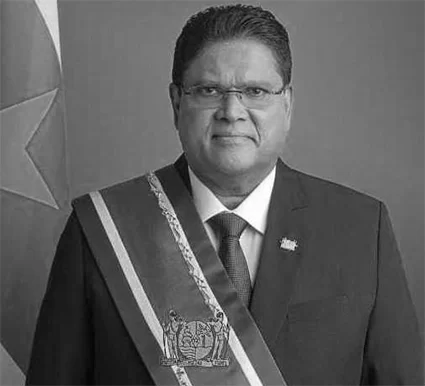
On April 7, the former president of Suriname, longtime chairman of the Vooruitstrevende Hervormingspartij (VHP) and sitting member of the National Assembly, Chan Santokhi, is cremated following his death on March 30, 2026 at the age of 67. For the VHP, one of Suriname’s most influential political parties, the day marks not only a moment of national farewell to one of its most iconic leaders, but also the official start of a new and uncertain political chapter for the organization. As politics never stops, even to mourn, the vacuum created by Santokhi’s passing has immediately shifted the party’s focus to the question of what comes next.
Santokhi was far from an ordinary party leader. Like the legendary VHP founder Jagernath Lachmon, he led the party from his election to the chairmanship until his final day. When he first won the top VHP position in July 2011, he secured a landslide victory, leaving his challenger Bholanath Narain far behind in the vote count. Over the 15 years that followed, he grew into the undisputed public face of the VHP, and had been preparing to defend his leadership position in the party’s scheduled leadership elections next year before his unexpected death. For the time being, the party’s gavel has been temporarily passed to deputy chairman Glenn Oehlers, but the arrangement is only an interim measure. The clock is already ticking inside the VHP, and the question of permanent leadership cannot be left unanswered long after the funeral.
The VHP’s official party structure leaves little room for off-book improvisation. The formal process requires local branch elections first, followed by a vote for the new national executive committee, a predictable, by-the-book sequence on paper. But anyone familiar with the VHP knows that beneath this orderly outward process, a fierce undercurrent of political dynamism is already shifting. To put it plainly: the contest for the vacant chairmanship began long before Santokhi’s passing. Several senior party figures had already begun preparing to challenge his incumbency ahead of next year’s scheduled vote; now that the position is open, that latent tension has erupted into an open leadership race. Political ambition, it turns out, does not get buried with a fallen leader.
The critical question facing the VHP today is not whether a leadership contest will occur, but how that contest will unfold. Will it devolve into a factional clash that tears the historic party apart? Or will it serve as a catalyst for the VHP to reinvent itself for a new political era? The party’s history offers both a reason for hope and a clear warning. When Jagernath Lachmon died decades ago, the VHP also stood at a breaking point. But as Lachmon himself once noted, the party bent like a reed in the wind rather than snapping. It emerged from the transition with scars, but enough resilience to remain a dominant force in Surinamese politics. That exact same test now sits before the party once again.
If the VHP can unify its fractured factions and rally around a consensus candidate that bridges internal divides, political analysts say the party could emerge stronger from this transitional period. But if personal ambition overrides collective party interests, fragmentation is a very real risk — a split that would strip the VHP of its long-held political clout. Ultimately, the future of the party does not rest solely with the senior leadership at the top: it depends on the support of the party’s grassroots base. Political parties do not survive on the charisma of individual leaders alone; they survive only if their foundational support holds when the political storm hits. And that storm is already on the horizon.
The coming months will reveal whether the VHP can once again bend without breaking, or whether the vicious fight for the chairmanship will throw the historic party off balance. One thing, however, is already certain: Chan Santokhi’s legacy will not be defined only by what he achieved during his decades of leadership. It will be defined by what the VHP does with the foundation he left behind. Today, as Santokhi’s body is committed to flame, the coming weeks and months will prove whether his party has the strength and unity to keep Santokhi’s political project alive and thriving.