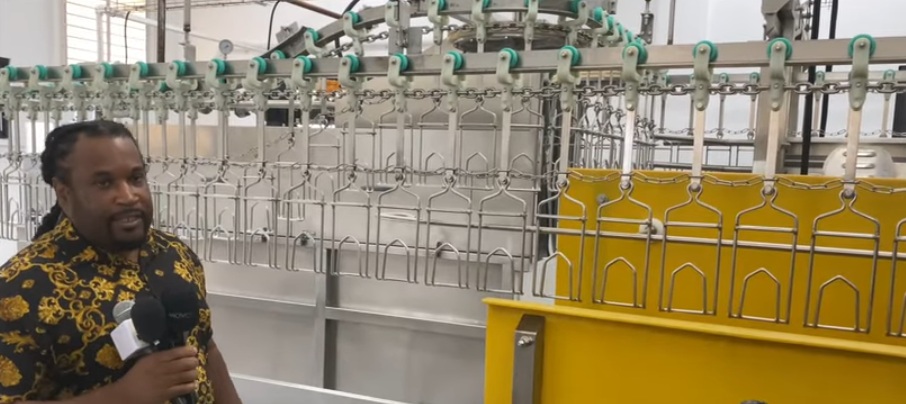
Nearly nine years after it was destroyed by one of the Caribbean’s most destructive hurricanes, Dominica’s long-awaited rebuilt national abattoir is on track to launch full operations by early summer 2026, a landmark development set to transform the small island nation’s food security trajectory, cut crippling import dependence, and breathe new life into its stagnant livestock sector.
During a recent media tour and readiness assessment of the Layou Park facility, National Abattoir General Manager Michael Etienne told reporters the flagship infrastructure project is now in its final phase, with full confidence in its upcoming launch. “Today’s walkthrough is a critical milestone,” Etienne shared as inspection teams tested the facility’s processing lines, safety systems and hygiene protocols. “It lets us verify what’s working, how it operates, and confirms that the years of work put into this project are enough to get the abattoir commissioned as soon as possible. We are 100 percent certain that by June, farmers will be supplying livestock, the abattoir will be running at full capacity, and the entire local meat industry will be revolutionized.”
While Etienne acknowledged the facility could potentially wrap up final checks and open ahead of the June timeline, he noted the government has intentionally targeted early summer to ensure every processing line – including those for poultry and pork – meets all international hygiene and safety compliance standards before going live.
The abattoir’s path to reopening has been marked by decades of progress, setback and renewed investment. The first iteration of the facility was built between 2012 and 2015 with financing from the Government of Venezuela, designed to modernize Dominica’s fragmented meat processing sector and give local livestock farmers a consistent, formal market. The original plant tested operations in 2015, with design capacity to process 1,000 birds per hour and 50 pigs daily. That progress was wiped out in 2017, when Category 5 Hurricane Maria swept across Dominica, leveling the Layou Park facility and bringing local commercial meat processing to a complete halt. In the years that followed, the loss of the abattoir pushed Dominica deeper into reliance on imported chicken and pork, highlighting the country’s persistent food security vulnerabilities.
It was not until 2024 and 2025 that the government of Dominica moved forward with a full rebuilding initiative, signing construction contracts to deliver a facility built to modern global standards. The project secured a core EC$6.4 million investment, with additional funding allocated to support upstream farmer development, including construction of climate-resilient livestock pens, improved local feed production, and expansion of national livestock herds. In January 2025, at the official contract signing, Ministry of Agriculture Permanent Secretary Ryan Anselm confirmed the upgraded facility would retain the original 1,000 birds per hour processing capacity, and outlined the government’s strategy to meet demand: the ministry will partner with 20 commercial poultry producers, each required to raise a minimum of 5,000 birds per production cycle to supply the plant. By early 2026, government officials confirmed the project was 90 percent complete, with full commissioning on track for mid-year.
In comments on the project, Prime Minister Roosevelt Skerrit emphasized the abattoir is a core pillar of the government’s broader national strategy to cut the country’s food import bill and put economic power in the hands of local agricultural producers. “Chicken parts are one of Dominica’s biggest single food imports,” Skerrit explained. “Our medium-term goal is to cut these imports by 50 percent, and eventually reach 100 percent self-reliance for all our meat needs.” The prime minister added that Dominica can first achieve full self-sufficiency in whole chicken production, with scaling up to cover processed chicken parts as local output expands in the coming years. He also noted that the new facility boasts far more advanced, modern processing equipment than the original Venezuelan-funded plant, allowing for higher quality meat processing and stricter food safety controls that will benefit both local producers and consumers.
To ensure the new supply chain remains sustainable and viable long-term, Etienne confirmed that targeted farmer training is already underway for all producers that will supply the abattoir. “We’ve reached out first to the farmers who supplied the original abattoir, and we’re also vetting new producers who are excited to be part of this new industry,” he said. The Ministry of Agriculture has already delivered building materials and labor support to more than 200 smallholder and commercial farmers to construct climate-resilient livestock pens, part of a broader EC$7.5 million national investment in livestock sector development.
Once fully operational, the abattoir will process both pork and poultry, giving local farmers a guaranteed formal market for their output and providing consumers with consistent access to affordably priced, hygienically processed local meat. Government economic projections estimate the facility will significantly cut the country’s annual import spending, boost rural household incomes across Dominica’s agricultural communities, and bring the country’s entire agri-food sector into line with modern global standards. With final readiness checks wrapping up and farmer training ramping up, the Layou Park abattoir is on track to welcome its first commercial processing runs this summer – almost a decade after Hurricane Maria forced its closure.