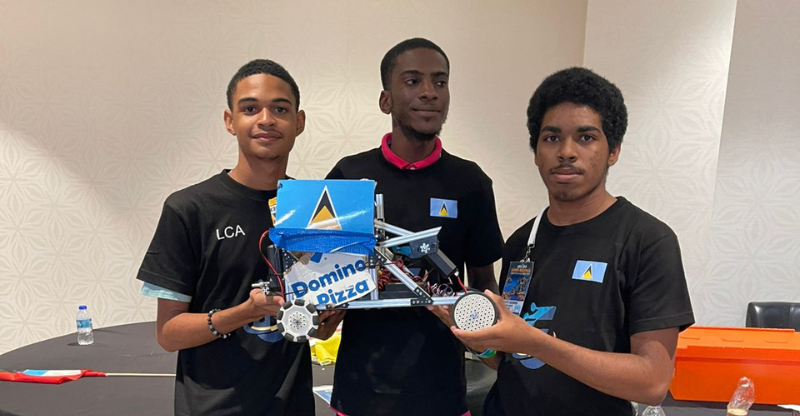
The inaugural Organization of Eastern Caribbean States (OECS) robotics competition, hosted in St. Kitts on March 21, brought together young engineering talent from across the region to tackle pressing real-world environmental challenges, with a central focus on innovative solutions for waste management. Among the competing teams, St. Mary’s College (SMC) from St. Lucia delivered an impressive performance, claiming fourth place and earning widespread pride from the institution’s entire student body and staff.
Leading the SMC team was Kyle Gajadhar, a dual major in science and business, who walked through the team’s design philosophy for their custom-built robot, dubbed “Helenite Prime”. Built specifically to align with the competition’s waste disposal theme, Helenite Prime was engineered to automatically collect and sort waste-like materials with notable speed and accuracy. Gajadhar explained that the robot’s design prioritized both flexible functionality and precise mechanical control: capable of identifying and picking up marked ball-shaped test objects, the machine then placed each item into corresponding pre-labeled containers to complete the sorting workflow.
Though the team encountered unexpected technical setbacks over the course of the competition, members left the event satisfied with their work and focused on the knowledge they gained throughout the months of preparation and on-site competition. Gajadhar’s teammate Matthew George and faculty advisor Jahim Malcolm, SMC’s information technology instructor, echoed this positive outlook, emphasizing that the event delivered far more value than just a final ranking.
For Malcolm, the greatest strength of the regional robotics competition lies in the unique cross-island collaboration and learning opportunities it provides. “We got to see different design approaches from teams across the region, and interact with our peers from other OECS member islands,” he noted. Beyond technical skills, the event allowed students to build new cross-regional friendships, pick up innovative engineering techniques, and gain hands-on experience that cannot be replicated in a traditional classroom setting. Gajadhar echoed this assessment, describing the event as a one-of-a-kind large-scale competition that pushed him and his teammates to grow. From learning to assemble custom mechanical and electronic components to refining iterative problem-solving processes, the practical skills gained are already shaping the students’ academic and career trajectories, he said.
On a personal level, Gajadhar shared that the most rewarding part of the experience was seeing months of collaborative work turn into a fully functional robot. While he hopes to claim the top prize in future events, he emphasized that the sense of personal and team accomplishment was the real highlight of the journey. Already, the SMC team is planning for next year’s competition: Gajadhar made it clear that the team has set its sights on the first-place trophy, joking that they have already cleared space on their display shelf for the win.
Looking ahead, Gajadhar is exploring career paths that combine his two passions, animation and computer science, and credits the competition with helping him clarify his technical interests. For SMC as an institution, Malcolm confirmed that the college will continue building on this year’s success, with a long-term goal of growing the school’s robotics program into a transformative initiative for student innovation. “We’re trying to create something revolutionary. We’re trying to make a difference,” Malcolm said, noting that the program is open to support from community individuals and local organizations as it expands.
In closing, both Gajadhar and Malcolm extended sincere gratitude to everyone who supported the team’s preparation and participation, including the second student representative Matthew George and all institutional and community backers who helped bring the Helenite Prime project to life.