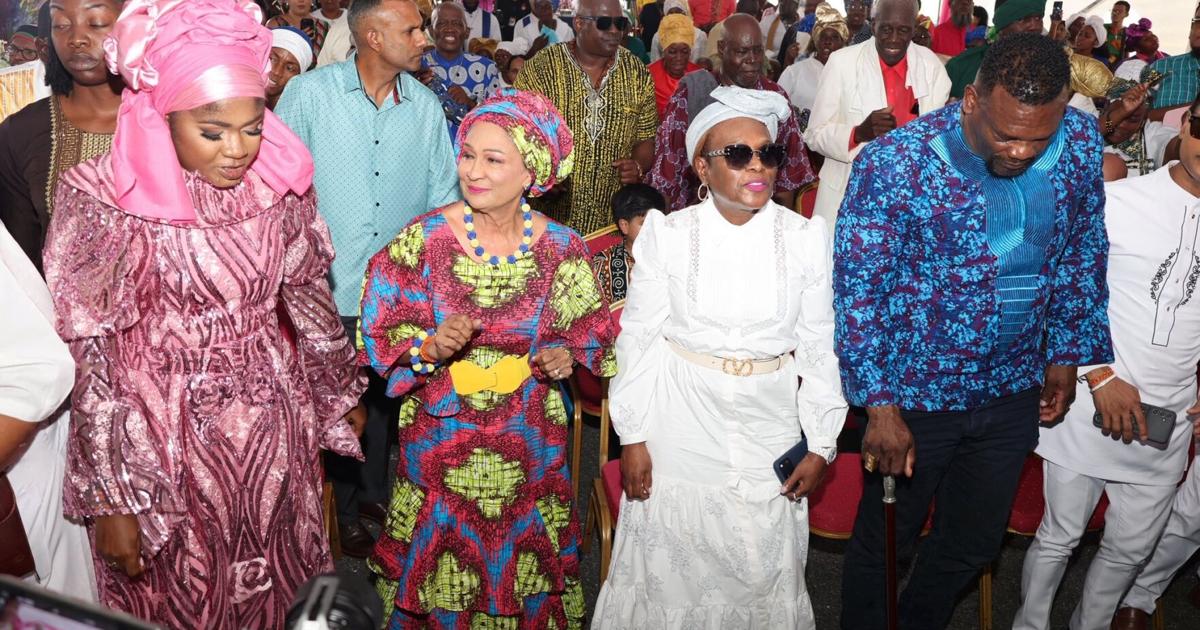
Trinidad and Tobago’s Prime Minister Kamla Persad-Bissessar used the stage of the annual Spiritual Baptist Liberation Day Thanksgiving Service to make a major policy pledge, reconfirming her administration’s plan to build a dedicated secondary school for the Spiritual Baptist community in Moruga. The event, held Wednesday at the Moruga Multipurpose Youth and Sport Facility, brought together faith leaders, elected officials, and hundreds of congregants to honor the faith’s centuries-long legacy of resistance and resilience.
The day of celebration began early, when local Member of Parliament Michelle Benjamin (representing Moruga/Tableland) led a vibrant parade through Moruga’s main streets. Accompanied by traditional drummers, folk dancers, and hymn singers, Benjamin joined Spiritual Baptist elders for the community’s sacred table-lighting ritual, a core practice of gratitude ahead of the main service. When Persad-Bissessar arrived later in the day, clad in traditional Spiritual Baptist attire, she was greeted with enthusiastic fanfare, as congregants pressed forward to greet her and worshippers lifted up traditional hymns. She was joined by a full contingent of her Cabinet, including House Leader Barry Padarath, Energy Minister Roodal Moonilal, Homeland Security Minister Roger Alexander, and Social Development Minister Vandana Mohit, all of whom joined her on stage for the keynote address.
In her remarks, Persad-Bissessar framed the new secondary school as the latest step in a decades-long partnership between her United National Congress (UNC) administration and the Spiritual Baptist community. She recalled that during her 1996 tenure as Minister of Legal Affairs, under the late former Prime Minister Basdeo Panday, she first secured a land grant for the community. Later, as Education Minister, she championed the opening of a local primary school, and during her current term as Prime Minister, she delivered the St Barbara’s Spiritual Shouter Baptist Primary School and a new Early Childhood Care and Education (ECCE) centre. The secondary school, she emphasized, is the next critical milestone in expanding educational access for the community.
“Land alone is not enough. The pathway out of poverty, to empowerment and dignity, is education. And now, God has brought me back into a position where I can once more deliver to this great community. On Friday, I announced in Parliament that your UNC Government will now establish your long-awaited secondary school,” she told the gathered crowd.
She pointed to the region’s existing Cowen Hamilton Secondary School, founded in 1962 by leaders of the Fifth Company Baptist Church as the first secondary school serving rural Baptist communities, as proof of the transformative impact of educational investment. “More than a school, it was upliftment through education, built through sacrifice, organisation, and vision,” she said.
Persad-Bissessar wove deep historical context and personal testimony into her address, highlighting the faith’s roots in resistance to colonial oppression. She reminded attendees that Spiritual Baptist traditions were forged by enslaved and free African people in Trinidad, and that for more than 30 years, practitioners were forced to worship in secret after British colonial authorities passed the 1917 Shouter Prohibition Ordinance, which criminalized their religious practices. “They prayed in the bush. They hid their bells. They muffled their voices. But they never stopped,” she said. “That resilience, that African resilience, is something every citizen of this country should honour and respect. They tried to silence you, but your faith grew stronger. They tried to diminish you, but your spirit became more deeply rooted in this land. And in that persecution, instead of extinguishing your light, they caused it to burn brighter.”
Opening up about her own personal connection to the faith, the Prime Minister shared a moving story from her childhood: when she was nine years old, her father Lilraj fell inexplicably ill, spending weeks at San Fernando General Hospital without a diagnosis or improvement. After months of decline, the family was urged to seek prayers from a Spiritual Baptist congregation in Penal. “And as God is my witness, from the very first service he attended, his health began to improve. And his life was spared,” she said. Following the miracle recovery, her entire family joined the church, and Persad-Bissessar was later baptized in the faith at Quinam Beach in Siparia, where a Mother Elder gave her guidance that she has carried throughout her life: “From this day, put God in front and walk behind.”
“I did not inherit this faith by ancestry. I was received into it by grace. And that, my brothers and sisters, is something I will never take for granted. The Spiritual Baptist Faith is a haven, a refuge. A place where an Indo-Trini girl from Siparia can be received, transformed, and be a beacon for the people,” she said.
Persad-Bissessar also noted that it was the 1996 UNC administration that secured full official recognition for the faith, establishing Spiritual Baptist Liberation Day as a national public holiday, making Trinidad and Tobago the only country in the world to grant this level of official recognition to the tradition. Repealing the 1917 ban and creating the holiday, she said, was an act of long-overdue corrective justice that cemented the faith’s place as a core part of Trinidad and Tobago’s national heritage. Parallel 75th Diamond Jubilee celebrations for the faith were also held Wednesday in Balmain, Couva, drawing hundreds of attendees from across the country.