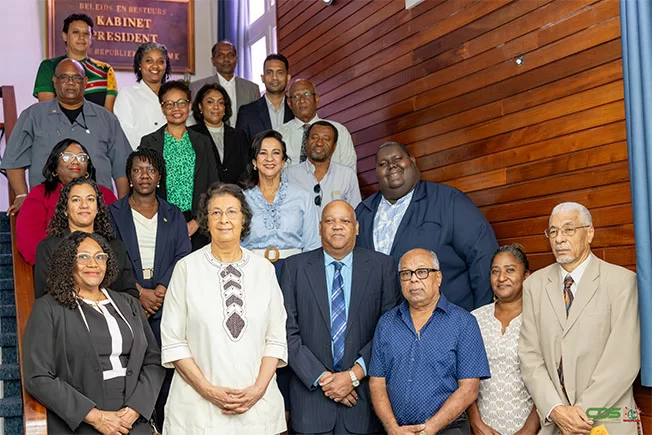
In a significant move to reshape national economic policy, President Jennifer Simons has formally reinstated the Socio-Economic Council (SER) as Suriname’s principal advisory body for sustainable development strategies. The installation ceremony, held Thursday at the Presidential Cabinet, marks the council’s return to active service after years of dormancy.
The newly constituted SER—chaired by Reggy Nelson and comprising representatives from government, private sector, and trade unions—has been tasked with providing both solicited and unsolicited counsel to the government and National Assembly. President Simons emphasized that Suriname must avoid over-reliance on future oil and gas revenues, urging instead for diversified economic development aligned with global trends and social justice principles.
Chairman Nelson echoed this vision, warning that exclusive focus on hydrocarbons would lead the nation into an economic dead end. He outlined the council’s mandate to identify sustainable sectors and formulate targeted policies for their growth. The SER will prioritize addressing complex challenges including international tensions whose impacts are already affecting Suriname’s economy.
Deputy Chair Robby Berenstein (trade unions) stressed the need for building consensus around socioeconomic policies, while Mervel Kotzebue (private sector) acknowledged the council’s historical inactivity but expressed optimism about its renewed mandate. Kotzebue emphasized creating long-term strategies for economic resilience, noting Suriname’s vulnerability to repeated economic shocks despite potential oil opportunities. Energy transition and climate change have been identified as cross-cutting themes in all council deliberations.