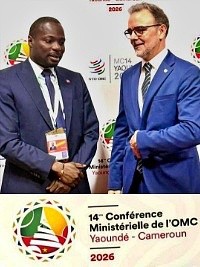
YAOUNDÉ, CAMEROON – March 25, 2026: Haitian Minister of Trade and Industry James Monazard articulated a comprehensive vision for transforming the World Trade Organization’s multilateral system during the Ministerial Meeting of Least Developed Countries. The gathering served as a preparatory session for the WTO’s Fourteenth Ministerial Conference (MC14).
Against a backdrop of escalating geopolitical tensions and mounting strain on multilateral frameworks, Minister Monazard presented Haiti’s official stance advocating for substantial systemic reform. He emphasized that the current international trading architecture requires significant restructuring to address persistent inequities and meet the legitimate developmental needs of emerging economies.
Haiti’s reform proposal centers on establishing a more equitable, transparent, and inclusive global trade governance model specifically designed to correct existing asymmetries. The initiative prioritizes the integration of developing nations’ interests, with particular emphasis on Least Developed Countries’ economic concerns.
Regarding agricultural negotiations, the Haitian delegation positioned food security as a fundamental sovereignty and stability issue for vulnerable economies. Minister Monazard demanded concrete advancements proportional to contemporary global challenges in this sector.
The Caribbean nation aligned itself with the G90 coalition’s position on special and differential treatment provisions, characterizing their adoption as crucial for LDCs’ meaningful economic integration. On fisheries subsidies, Haiti endorsed a balanced approach that reconciles marine conservation objectives with developing nations’ socioeconomic requirements.
Beyond conventional trade matters, Haiti advocated for an expanded developmental perspective encompassing technology transfer mechanisms, reduced remittance costs, enhanced Aid for Trade programs, and improved trade-environment policy coordination.
In his concluding remarks, Minister Monazard challenged WTO members to demonstrate genuine multilateral commitment through actionable outcomes benefiting the most vulnerable economies. He asserted that MC14’s historical significance will be measured by its capacity to deliver tangible, inclusive results that advance fair, equitable, and development-centered global trade governance.