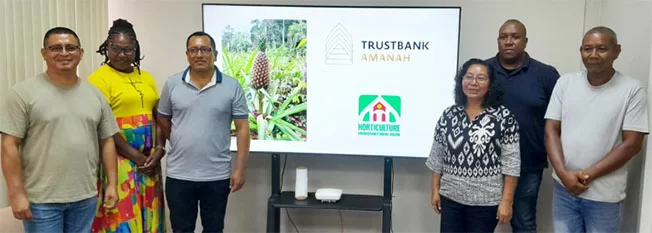
Six indigenous pineapple growers in Suriname have formalized loan agreements to expand organic pineapple production, marking a significant advancement in strengthening the country’s agricultural value chain. The milestone signing ceremony occurred on Monday as part of the Agrifood Systems Transformation Accelerator (ASTA) Joint Programme, a collaborative initiative involving four United Nations agencies—FAO, UNIDO, UNFPA, and ILO—in partnership with the Surinamese government.
Funded by the Joint SDG Fund and Islamic Development Bank, the program specifically targets sustainable development within Suriname’s pineapple sector. Approximately 90% of pineapple farmers in Suriname are indigenous communities operating collectively owned lands in Para’s village territories. Their lack of individual land titles has historically prevented access to traditional bank financing due to insufficient collateral.
To overcome this barrier, ASTA established a Collateral Facility Fund managed by Trustbank Amanah (TBA), which serves as guarantee security for financial institutions. Roshnie Gangapershad, Acting Agri Business Manager at TBA, explained that loan applications undergo rigorous feasibility assessments before approval.
The Horticulture Innovation HUB, established in 2024 under the ASTA project, provides comprehensive support through two core pillars: enhanced agricultural practices and strengthened agro-entrepreneurship. National agronomist Hemwatie Goeptar detailed the technical assistance process, which begins with thorough agronomic analysis covering field conditions, planting design, and fertilization programs developed in consultation with farmers and village leadership.
Practical implementation is already underway. Farmers Jerry Birambie and Harvey Read from Pierre Kondre have prepared one-hectare plots for soil enhancement and planting. Despite equipment accessibility challenges in remote regions—Jeanne Patra from Marowijne requires machinery transported from Para—the program maintains momentum through adaptive solutions.
Continuous field support remains crucial to the project’s success. Goeptar and field agents assist growers with irrigation, fertilization, and maintenance protocols. The application of artificial flower induction technology enables year-round production, with flowering induced after nine months and harvest occurring approximately fourteen months post-planting.
Additional growers are preparing for expansion. Stuart Makosie from Powaka will commence land preparation shortly, while Cyrell Sabajo from Matta has established an on-site bio-factory for organic fertilizers and natural pesticides following training sessions.
According to Swami Girdhari of the Horticulture Innovation HUB, the project aims not only to increase production but also to modernize the sector and attract youth participation. Innovative digital applications facilitate knowledge sharing, communication, and monitoring. Future phases will focus on processing and value-added pineapple products to enhance market opportunities both domestically and for export.