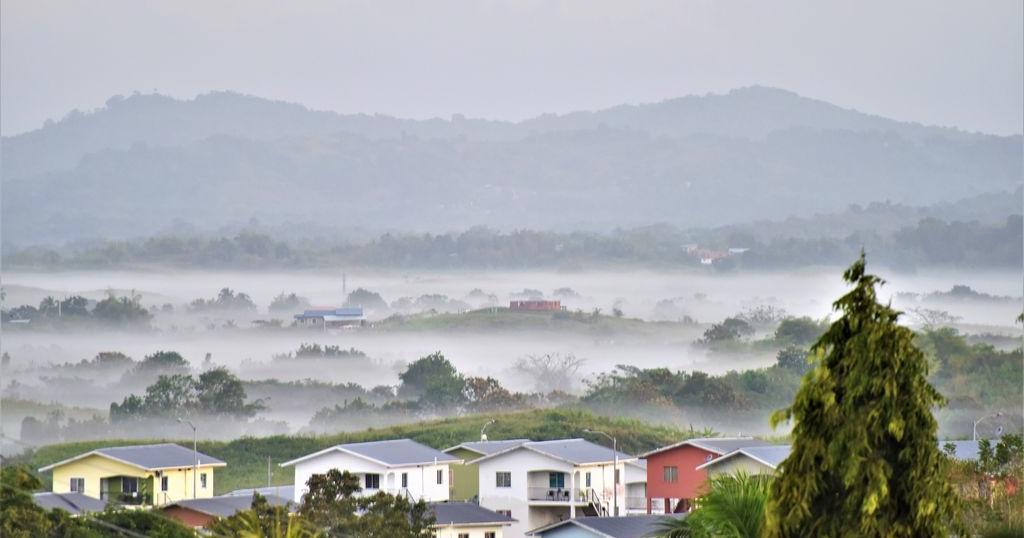
Residents across southern Trinidad’s low-lying regions and undulating hills have been treated to a spectacular meteorological display in recent days, observing one of nature’s most elusive atmospheric phenomena. Each dawn has unveiled an expansive sea of fog enveloping valleys and hovering above swamp territories in a breathtaking natural exhibition.
The dense concentration of suspended water droplets creates such pronounced opacity in certain areas that motorists must engage vehicle headlights for safe navigation, with visibility frequently dropping below 100 meters. This ephemeral natural spectacle maintains its presence only briefly during the early morning hours, gradually dissipating as solar intensity increases following sunrise.
This remarkable phenomenon finds its explanation in complex atmospheric thermodynamics. The observed fog formation constitutes a classic demonstration of temperature inversion—a meteorological condition where the normal atmospheric temperature gradient becomes inverted. During stable nocturnal conditions, the Earth’s surface and adjacent atmospheric layers undergo radiational cooling, emitting long-wave radiation into space.
This process triggers a cascade of thermodynamic responses: the cooled ground surface induces temperature inversion conditions, causing moist air near the terrestrial boundary to cool toward its dew point temperature. Depending on substrate moisture availability, additional evaporation may occur, effectively elevating the dew point within this stabilized atmospheric stratum and consequently accelerating radiation fog development through enhanced condensation nuclei activity.