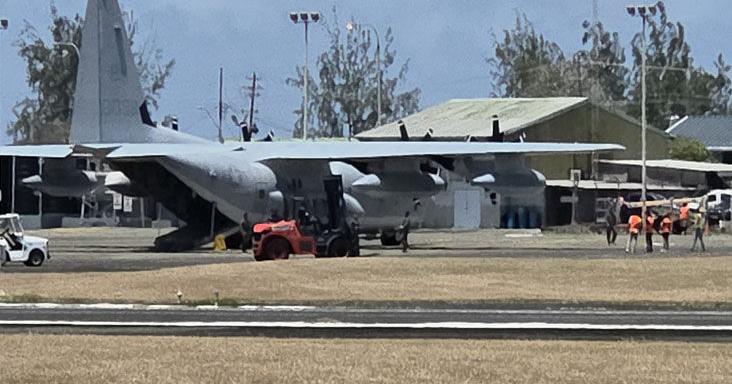
A United States Marine Corps KC-130J aircraft executed a covert operation in Tobago yesterday, reportedly extracting the sophisticated AN-TPS-80 Ground/Air Task Oriented Radar (G/ATOR) system that had been stationed at the ANR Robinson International Airport. Intelligence sources confirm the aircraft originated from Roosevelt Roads in Puerto Rico, completing a round-trip mission to retrieve the mobile defense apparatus.
The radar’s disappearance marks a dramatic development in a four-month geopolitical saga that began when the US military installed the system last year. The Trinidad and Tobago government had consistently characterized the radar’s presence as part of counter-narcotics operations, authorized at the personal request of Prime Minister Kamla Persad-Bissessar.
However, former military commander Lieutenant Norman Dindial, who previously headed the National Coastal Surveillance Radar Centre, contends the system’s removal exposes its true purpose. “It shows that it was not supposed to be used for drug interdiction,” Dindial stated. “This $50 million piece of equipment was in our territory doing nothing for our stated needs. I believe its mission was to support the incursion in Venezuela.”
The timeline reveals strategic patterns: The radar first appeared in late November following high-level discussions between Prime Minister Persad-Bissessar and General Dan Caine, Chairman of the US Joint Chiefs of Staff. This installation preceded Operation Absolute Resolve and coincided with increased US military activity in Caribbean waters.
Current geopolitical context suggests the radar may be redeployed to address Middle Eastern conflicts. The New York Times recently documented Iranian strikes damaging US communication and radar systems across seven military sites. Dindial theorizes the Tobago radar is being repositioned to strengthen US assets in the Persian Gulf: “There is a gap in the sensory aspect over there, and the US military is repositioning its assets.”
The government’s narrative has faced previous challenges. In December, the Trinidad and Tobago Police Service claimed the radar generated intelligence leading to a $171 million marijuana seizure, though manufacturer Northrop Grumman subsequently clarified the system wasn’t designed to track maritime or ground targets. Defense Minister Wayne Sturge had recently asserted the radar would remain for the “foreseeable future” to compensate for limited coast guard capabilities.