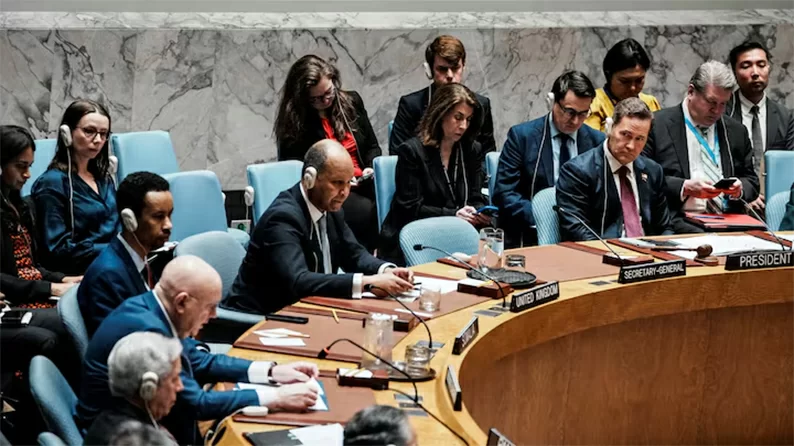
The United Nations Security Council witnessed a sharp diplomatic confrontation on Thursday as the United States and its Western allies clashed with Russia and China regarding Iran’s nuclear program. The heated exchange occurred during a meeting chaired by the U.S., which currently holds the Security Council presidency for March.
The session turned contentious when Russia and China attempted to block discussions concerning the so-called 1737 Committee, the UN body responsible for monitoring and enforcing sanctions against Iran. Their effort was defeated by a vote of 11-2, with two abstentions, allowing the proceedings to continue.
U.S. Ambassador Mike Waltz accused Moscow and Beijing of protecting their ally Tehran by obstructing the sanctions committee’s work. He called for all UN member states to maintain weapons embargoes against Iran, prohibit missile technology trade, and freeze relevant financial assets. Waltz emphasized that these measures specifically target concerns regarding Iran’s nuclear, missile, and conventional weapons programs, along with its alleged support for terrorism.
The American diplomat asserted that Russia and China are preventing a functional sanctions committee to preserve their defense cooperation with Iran, which he claimed has been repeatedly prohibited. He referenced a recent International Atomic Energy Agency (IAEA) report confirming that Iran, as the only non-nuclear weapons state, has enriched uranium to 60% purity while denying access to these stockpiles.
Russian Ambassador Vassily Nebenzia countered that the U.S. and its allies were promoting ‘hysteria’ about alleged Iranian nuclear weapons plans that have never been confirmed by the IAEA. He characterized American military actions targeting Iran as attempts to escalate tensions throughout the Middle East and beyond.
China’s representative Fu Cong labeled Washington ‘the instigator’ of the nuclear crisis and criticized the use of military force during negotiations, which he stated rendered diplomacy meaningless.
Iranian Ambassador Amir Saeid Iravani maintained that his country’s nuclear program has always been peaceful and that Iran does not recognize any sanctions.
The discussion referenced President Donald Trump’s previous justification for military action, claiming that Iran would have developed nuclear weapons within two weeks had the U.S. not bombed three nuclear facilities in June. However, intelligence agencies have disputed this assertion.
Britain and France supported reinstating sanctions, arguing that Iran’s lack of accountability regarding its nuclear activities warrants such measures. France warned that the IAEA can no longer guarantee the peaceful nature of Iran’s program and noted that Tehran has accumulated sufficient nuclear material for ten weapons.