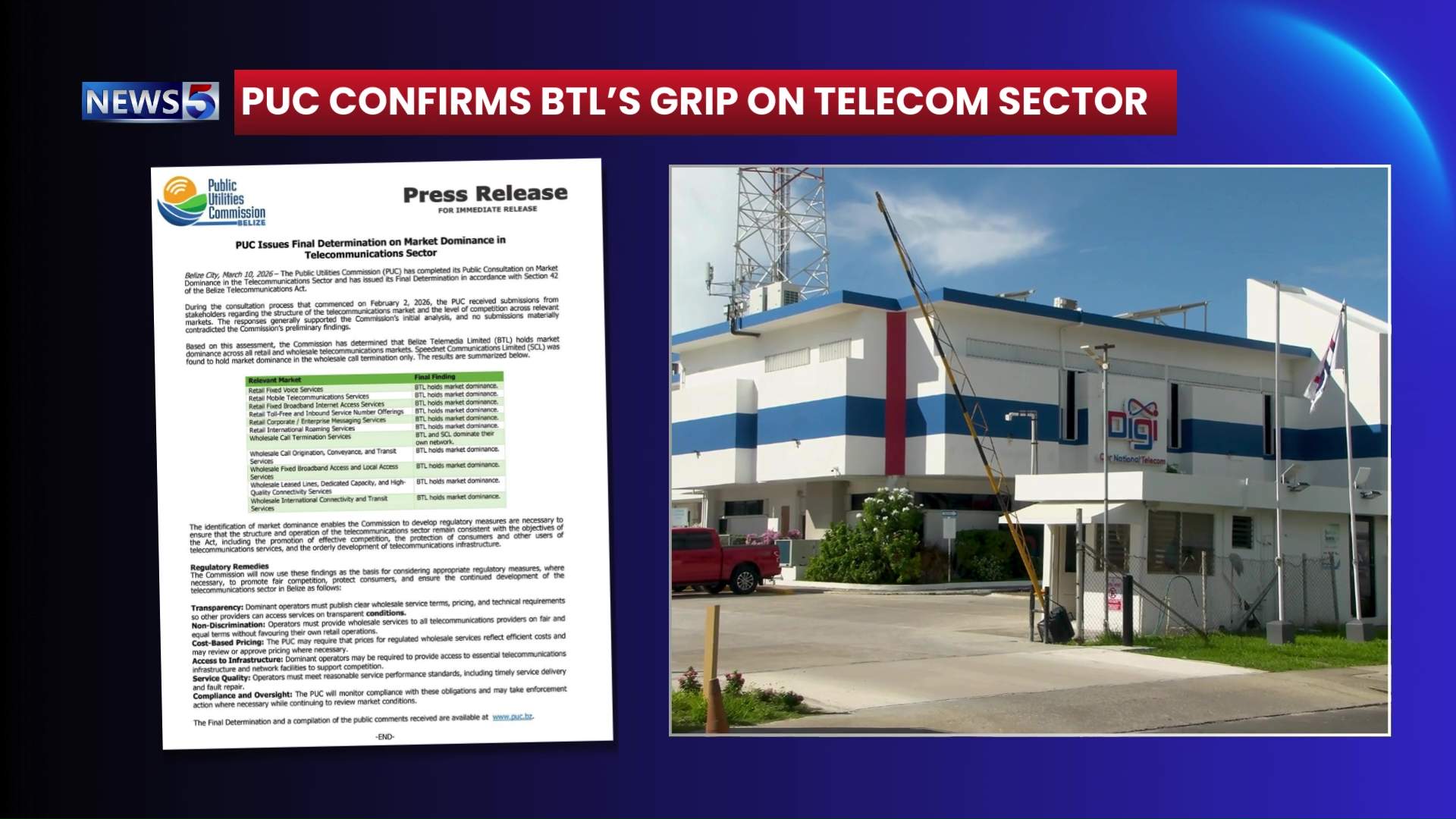
Belize’s telecommunications landscape faces potential restructuring after the Public Utilities Commission (PUC) formally designated Belize Telemedia Limited (BTL) as the dominant player across nearly all retail and wholesale markets. The landmark determination, finalized following extensive public consultation, encompasses mobile services, broadband provision, and international connectivity infrastructure.
The regulatory assessment revealed widespread stakeholder consensus regarding BTL’s market supremacy, particularly concerning control over the critical ARCOS-1 submarine cable landing station. This infrastructure advantage enables BTL to function simultaneously as bandwidth wholesaler and retail competitor, creating what industry participants describe as an unlevel competitive landscape.
Evan Tench, Chairman of the Belize Cable Television Operators Association, articulated the concerns of independent providers: “BTL controls the landing site and imposes markup on bulk bandwidth before selling to operators. This creates wholesale price disparities that extend into retail markets where we compete directly.”
Cable operators are advocating for direct infrastructure access at cost-based rates, free from BTL’s intermediary role. Additionally, they highlight the competitive disadvantage stemming from BTL’s ability to offer quad-play bundles—combining mobile, broadband, fixed-line, and content services—while smaller providers lack access to essential components.
The industry association proposes regulatory changes that would enable cable operators to enter mobile services through MVNO arrangements, obtain numbering resources for fixed-line offerings, and secure equitable interconnection terms. These measures, they argue, would establish genuine market competition rather than the current asymmetrical arrangement.
Speednet Communications, drawing on two decades of operational experience, submitted detailed recommendations emphasizing practical solutions including regulated access to passive infrastructure, cost-oriented interconnection rates, and equitable treatment at critical facilities.
The PUC has indicated it will implement regulatory measures to enhance transparency, ensure non-discriminatory access to essential services, and strengthen consumer protections while promoting infrastructure development. This determination raises broader questions about market concentration, investment protection for government and Social Security Board holdings in BTL, and the long-term evolution of Belize’s telecommunications sector.