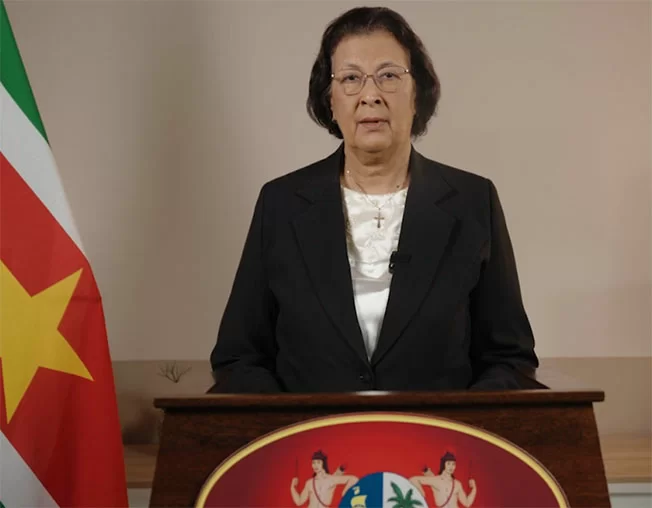
President Jennifer Simons has declared an accelerated implementation of social support measures to counter the economic repercussions of the Middle East conflict on Suriname. Addressing the nation in a televised statement, the head of state emphasized that international tensions are directly impacting the country’s economy, prompting immediate government intervention.
In her address to citizens, President Simons outlined the global economic consequences of the prolonged Middle Eastern conflict, noting that its duration directly correlates with increasing domestic impact. The administration has initiated broad consultations with national security councils, private sector representatives including ASFA, VSB and AKMOS, coalition leadership and opposition figures, labor unions, and the Association of Economists of Suriname (VES). Additional meetings are scheduled with the Surinamese Association of Journalists and other specific societal groups.
The government has conducted emergency cabinet sessions to assess the conflict’s implications on national programming. Recognizing the existing economic challenges faced by citizens, authorities have fast-tracked previously announced support measures through renewed consultations with the Ministry of Finance, accounting for effects on state revenue streams.
Key relief measures include:
– Child benefits increasing to SRD 250 for both general and civil servant categories by end-March
– Supplementary allowance of SRD 1,000 for persons with disabilities, elderly pensioners, and registered vulnerable households
– Purchasing power reinforcement of SRD 1,500 for civil servants and government employees
– Special support allowance of SRD 2,500 for teachers
Notably, these amounts—originally scheduled for phased distribution—will now be disbursed in full by March’s conclusion. Higher income groups, including government members, high state council officials, directors and sub-directors are excluded from these benefits.
Concurrently, the government is intensifying efforts to boost state revenues while acknowledging the necessity of comprehensive mitigation strategies through collaborative engagement with all societal actors. President Simons concluded with an appeal for national unity, emphasizing that cooperation between government and citizens remains essential to navigate these externally-driven challenges, invoking traditional wisdom of collective resilience.