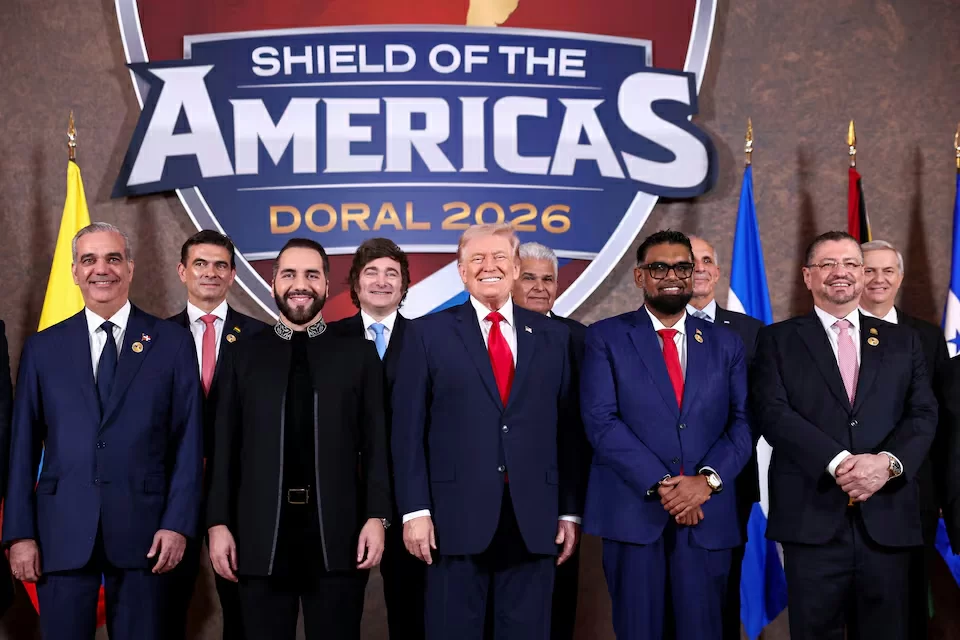
In a significant strategic move following recent military operations in Iran, former U.S. President Donald Trump convened leaders from Latin America and the Caribbean in Miami, Florida, to formally establish a multinational military coalition targeting drug trafficking organizations. The Saturday summit, dubbed “Shield of the Americas,” represents a cornerstone of Trump’s broader regional security initiative aimed at dismantling criminal networks operating throughout the Western Hemisphere.
The gathering brought together at least twelve heads of state, including Argentine President Javier Milei, Salvadoran President Nayib Bukele, Chilean President-elect José Antonio Kast, Honduran President Nasry Asfura, and Ecuadorean President Daniel Noboa. During the proceedings, Trump characterized drug cartels as “savage animals” and signed an official proclamation launching the coalition framework. The former president appointed recently resigned Homeland Security Secretary Kristi Noem as special envoy to the initiative, despite congressional criticism surrounding her prior tenure.
Analysts view the coalition as serving dual purposes: demonstrating domestic strength amid Middle East instability affecting energy prices, and countering China’s expanding influence across Latin America. The development comes ahead of Trump’s planned March meetings with Chinese President Xi Jinping in Beijing.
Participants predominantly share Trump’s right-leaning approach to security and migration, favoring aggressive law enforcement tactics over social reforms and promoting private enterprise rather than state intervention. This alignment reflects a broader conservative shift in several Latin American nations as the region navigates competing influences from Washington and Beijing.
China’s growing economic footprint in the region has raised concerns in U.S. policy circles. bilateral trade reached a record $518 billion in 2024, while Beijing provided over $120 billion in loans supporting infrastructure projects from Argentine satellite stations to Peruvian ports. In response, the U.S. has pressured regional governments to restrict Chinese involvement in critical infrastructure, recently supporting Panamanian actions against a Hong Kong-based company operating in the vital Panama Canal waterway.
Additional measures include the January capture of Venezuelan President Nicolas Maduro and strengthened sanctions against Cuba, signaling a determined U.S. effort to diminish Chinese regional influence and end what officials characterize as an era of cheap oil in exchange for debt financing.