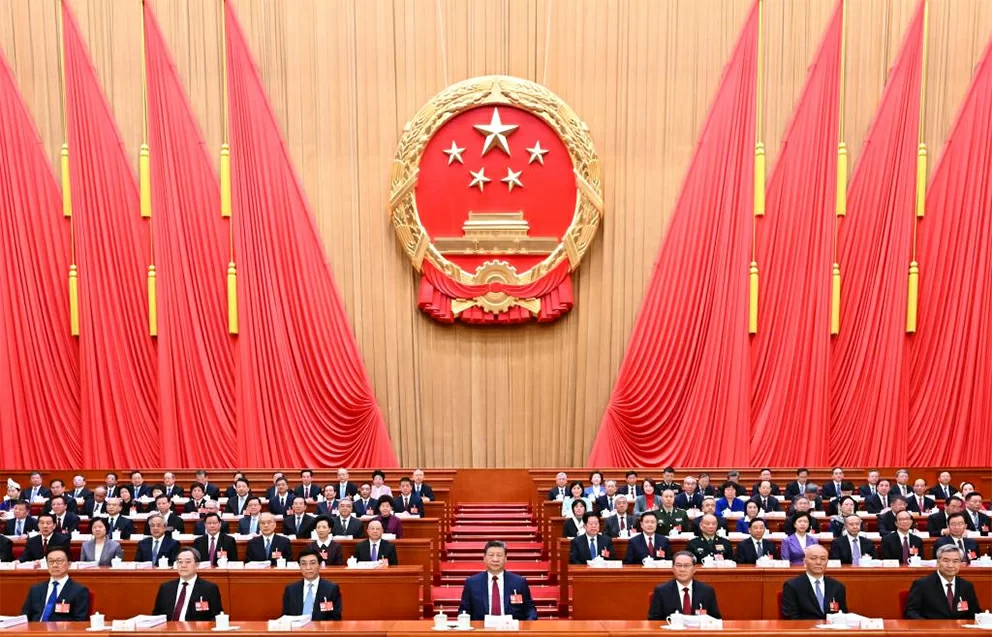
Beijing witnessed the commencement of the 14th National People’s Congress (NPC) on March 5, 2026, with President Xi Jinping and senior Chinese leadership presiding over the pivotal political gathering. The annual session unveiled China’s economic blueprint for the coming year, featuring a notably conservative GDP growth target of 4.5-5%—marking the first instance of sub-5% targeting in the nation’s recent economic history.
This calibrated growth projection reflects China’s strategic response to persistent economic headwinds, predominantly driven by the collapse of its real estate sector which previously constituted 25-30% of GDP. Economic analyst Tianchen Xu from the Economist Intelligence Unit interprets this adjustment as signaling a fundamental policy shift: moving from quantitative expansion metrics toward qualitative growth indicators emphasizing household income elevation and enhanced public service accessibility.
Concurrent with economic recalibration, China announced a 7% defense budget increase—the smallest increment in five years yet remaining regionally competitive. The nation continues its technological pivot with sustained state subsidies for strategic sectors including integrated circuits, aerospace, biomedicine, and drone application ecosystems termed the ‘low-altitude economy’.
Social governance priorities featured prominently in congressional deliberations, with policies addressing demographic challenges through enhanced childcare support systems and elderly care services for China’s aging population. Environmental commitments reaffirmed the 2030 carbon emissions peak target while accelerating transition timelines toward renewable energy adoption.
The parallel convening of the Chinese People’s Political Consultative Conference (CPPCC) complements NPC proceedings, collectively forming the ‘Two Sessions’ that shape China’s policy trajectory. A seminal outcome emerges through the presentation of the 15th Five-Year Plan (2026-2030), outlining medium-term development objectives targeting doubled per-capita GDP by 2035 relative to 2020 benchmarks.