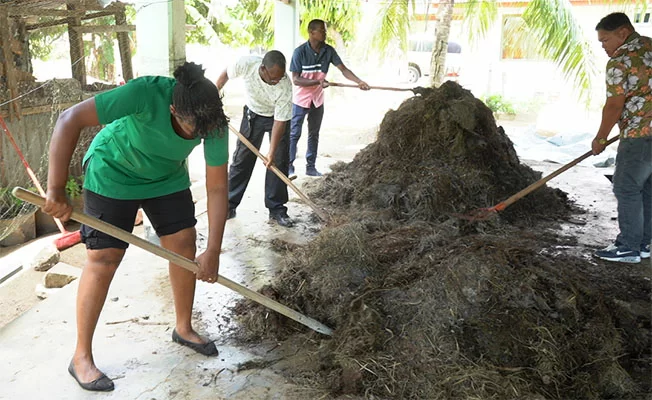
Coronie, one of Suriname’s most agriculturally significant districts, has successfully concluded an intensive three-month training program on Traditional Compost production, marking a substantial advancement in sustainable farming practices. The program, which commenced on November 20, 2025, focused on mastering the complete process of creating traditional compost, locally known as ‘blaka doti.’
William Waidoe, Deputy Director of Western Agriculture at the Ministry of Agriculture, Livestock and Fisheries (LVV), emphasized during the closing ceremony that while training remains crucial, the practical application of acquired knowledge holds even greater importance. He highlighted Coronie’s exceptionally fertile soil as ideally suited for agricultural development and reaffirmed LVV’s role as the authoritative body providing essential knowledge transfer to realize this potential.
A notable aspect of the Coronie training was the overwhelming participation of women, who constituted the majority of attendees. Among them was Leonie Kerseboom-Lynch, a professional midwife who immediately implemented her training by constructing a compost heap alongside her husband to support his agricultural activities. Her primary motivation stemmed from composting’s environmental benefits, noting that the process not only offers sustainable organic waste management but also creates potential revenue streams through surplus compost sales while contributing to cleaner living environments.
This training initiative forms part of the broader ‘Strengthening of Citrus Production’ project, funded by the Inter-American Development Bank (IDB). The project aims to enhance Suriname’s citrus production capabilities through improved facilities at LVV citrus nurseries and the production of high-quality planting materials. Quality growth medium in plant bags has been identified as essential to this endeavor, prompting the establishment of compost camps and training sessions across various LVV ressort offices, experimental gardens, and nurseries for both ministry staff and interested community members.
Soesila Ramautar of the Directorate of Agricultural Research, Marketing and Processing (DLOAV), who led the training with her team, expressed considerable satisfaction with the outcomes. This event marked Coronie’s first participation in compost training at this level and represented the final compost training activity within the IDB-funded citrus project framework.