Despite independent investigations revealing that GuySure holds no legal subsidiary status with state-owned mining company Grassalco, operations in Guyana continue uninterrupted. Since the suspension of CEO Wesley Rozenhout on January 12 alone, over US$13,000 has been expended on business trips and participation in an energy conference, with monthly expenditures nearing US$300,000.
Information obtained by Starnieuws indicates that GuySure’s activities persist unabated despite ongoing investigations initiated by the Board of Commissioners. The company’s shares are held by five natural persons, including the suspended Rozenhout.
Personnel deployments to Guyana continue every two weeks to conduct operations at GuySure’s leased port facility in Georgetown. Currently, only one Guyanese employee operates locally, with the majority of work being performed by Surinamese staff. Prior to recent controversies, minimum five personnel would travel per shift, though this has been reduced to two or three individuals per deployment since January.
Ten employees have been dispatched to the neighboring country since mid-January at a cost of approximately US$13,000, excluding US$50 per diem allowances for each worker. Additionally, US$4,600 was spent leasing a booth at Guyana’s energy conference. Although participation was formally under Grassalco’s banner with adjusted promotional materials, the decision to proceed was made due to prior reservations. Sources indicate final costs exceeded initial projections.
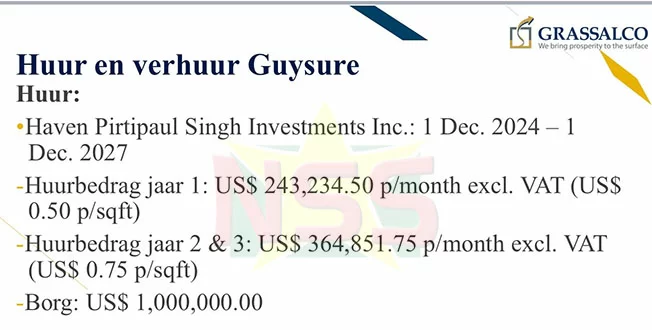
Monthly financial obligations extend beyond personnel expenses, including US$243,000 (excluding VAT) for port facility rentals and US$8,000 for two residential properties. Combined with other operational costs, monthly expenditures surpass US$300,000.
GuySure operates at a significant deficit, with previously reported figures showing approximately US$9 million in expenditures against merely US$2 million in revenue. Current crushed stone prices also fail to meet earlier calculated benchmarks.
Operations will continue pending government authorization to terminate activities. Rozenhout’s suspension has thus far not prompted policy changes, while legal teams examine termination consequences and relevant international obligations and conditions.