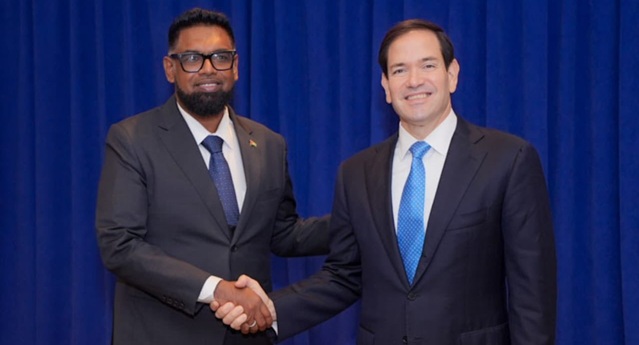
In a significant diplomatic development, United States President Donald Trump has extended invitations to the leaders of Guyana and Trinidad and Tobago for a high-level security conference scheduled for March 7 in Miami, Florida. This strategic gathering represents Washington’s continued commitment to strengthening regional security partnerships with key Caribbean Community (CARICOM) allies.
The announcement came during the CARICOM mid-term summit in St. Kitts, where Guyana’s President Irfaan Ali revealed the meeting would address pressing regional security challenges. “This engagement focuses on security matters and regional challenges, aiming to enhance our coordination mechanisms,” President Ali stated during a press briefing.
Trinidad and Tobago’s Prime Minister Kamla Persad-Bissessar, who has openly credited US military cooperation with reducing murders in her nation by 42%, confirmed her participation. In her summit address, she emphasized that “partnership with the US strengthens rather than undermines Caribbean sovereignty, enabling us to combat destabilizing forces across our hemisphere.”
The diplomatic revelation followed US Secretary of State Marco Rubio’s commitment to CARICOM leaders regarding intensified efforts to combat firearms trafficking from American sources to Caribbean nations. Secretary Rubio acknowledged the alarming sophistication of criminal organizations’ weaponry, much of which originates from the United States. “We recognize our responsibility and are working diligently with law enforcement agencies to disrupt these trafficking networks,” he asserted.
Rubio further highlighted the interconnected nature of transnational criminal operations, noting that narcotics traffickers and other criminal elements utilize sophisticated weapons funded by profits from American markets. This criminal ecosystem, he warned, poses significant threats both to transit countries and ultimately to US national security.
The Secretary of State characterized transnational criminal organizations as the region’s most urgent security threat, noting their resources often rival or exceed those of the nation-states they target. “While we have a established history of cooperation, our collaborative efforts must deepen as these criminal networks grow increasingly powerful,” Rubio emphasized.
Guyana’s security partnership with the United States has particularly strengthened following US support during territorial tensions with Venezuela. The US military currently collaborates with Guyana on maritime and air domain awareness, while agencies including the Drug Enforcement Administration provide specialized training in narcotics detection and border protection.
Prime Minister Persad-Bissessar provided concrete evidence of this security cooperation’s effectiveness, citing a dramatic reduction in murders from 623 in 2024 to 366 in 2025. She attributed 40% of previous violent crimes to gang activities fueled by narcotics and firearms smuggling from Venezuela, acknowledging that “US military cooperation has been instrumental in enhancing our national security capabilities.”