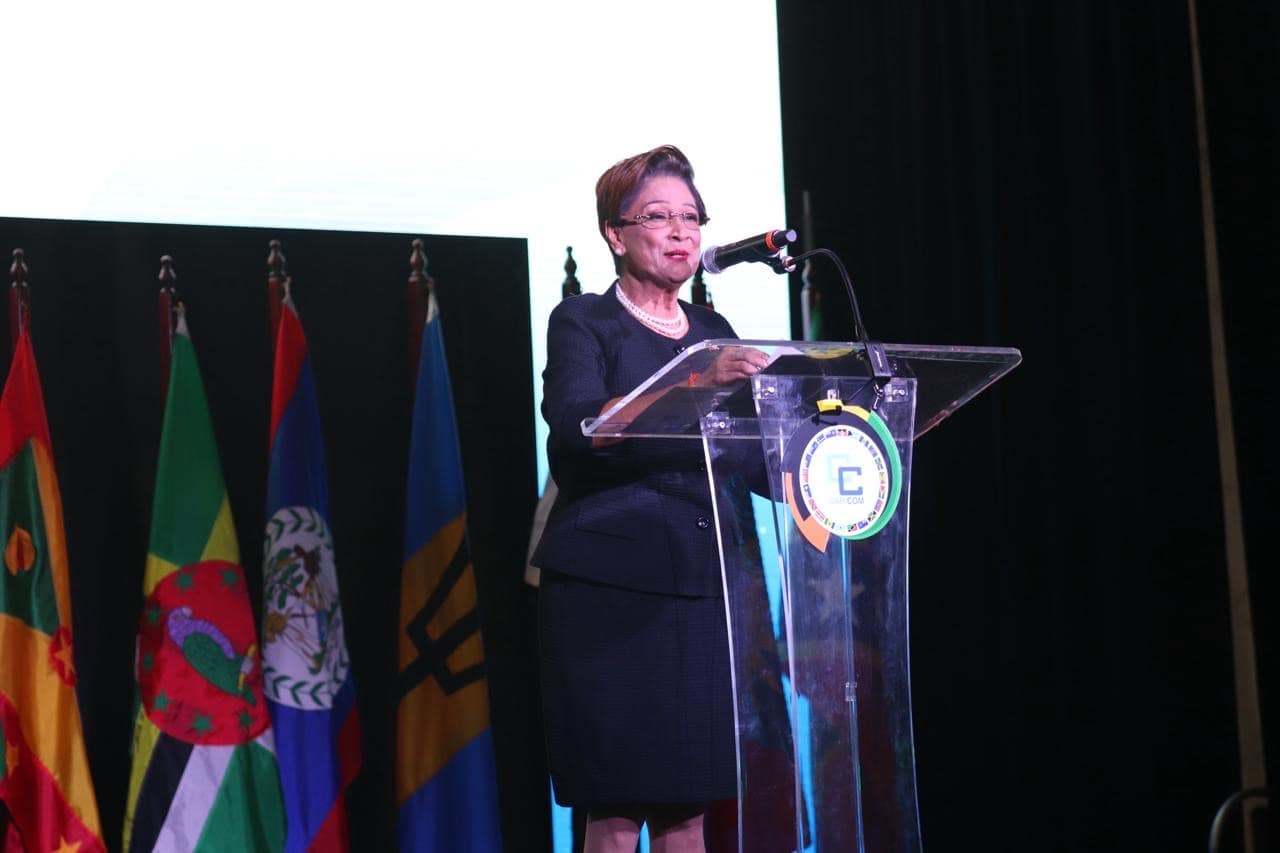
Kamla Persad-Bissessar, Leader of the Opposition in Trinidad and Tobago and head of the United National Congress (UNC), has launched a significant critique against the Caribbean Community (CARICOM), asserting that the regional body systematically sidelines opposition voices across member states. Her statements, delivered during a recent political address, highlight a growing tension between regional governance and domestic political dynamics.
Persad-Bissessar articulated that CARICOM’s engagement model predominantly favors incumbent governments, effectively excluding elected opposition representatives from critical dialogues and decision-making processes. This approach, she contends, undermines democratic principles and creates an information deficit for alternative governments, who are consequently ill-prepared to assume national leadership roles. She emphasized that this practice not only disenfranchises a substantial segment of the Caribbean electorate but also potentially weakens regional cohesion and policy continuity.
The veteran politician framed this alleged exclusion as a deliberate strategy that consolidates power for sitting administrations while stifling robust, multi-partisan debate on pressing regional issues. Her critique extends beyond Trinidad and Tobago, suggesting a pan-Caribbean pattern where the voices of parliamentary opposition parties are conspicuously absent from high-level CARICOM summits, working groups, and diplomatic negotiations.
This accusation raises profound questions about transparency, inclusivity, and the very nature of governance within the 15-member bloc. It implies that CARICOM’s effectiveness and legitimacy could be compromised if it fails to incorporate diverse political perspectives from its member nations. The challenge presented by Persad-Bissessar calls for a potential restructuring of how the community interfaces with all elected officials, not just those currently in executive power, to foster a more resilient and representative regional partnership.