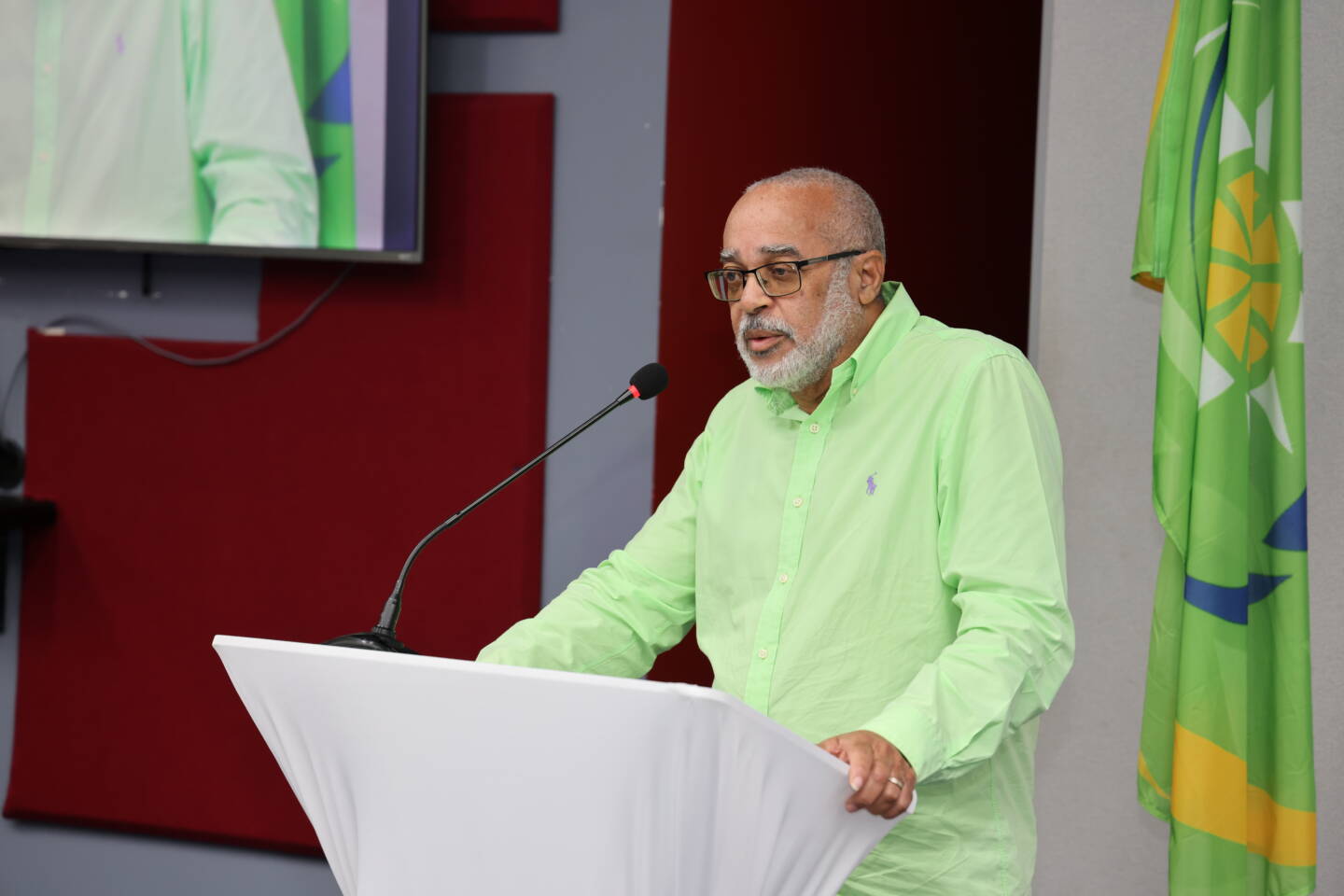
In a profound address resonating across the Eastern Caribbean, Dr. Didacus Jules, Director General of the Organisation of Eastern Caribbean States (OECS), has amplified Professor Justin Robinson’s stark declaration that ‘No One is Coming to Save Us.’ This statement, originally articulated in a widely circulated article, serves as a catalyst for redefining regional sovereignty and self-reliance in an increasingly fragmented global landscape.
Dr. Jules contextualizes this realization not as a cause for despair but as a necessary awakening from long-held illusions. The past year has dismantled the Caribbean’s enduring belief that international systems, historical partnerships, or benevolent allies would provide sanctuary during crises. Major powers are recalibrating strategies to serve their own interests, concessional finance is diminishing, migration pathways are constricting, and the rules-based international order proves malleable to the whims of the powerful. This represents a fundamental structural shift, not a temporary disruption.
For the OECS, the path forward is neither isolation nor empty bravado, but deliberate design. True sovereignty for small states, argues Jules, is not achieved through solitary defiance but through strategic pooling of capacities where size is a disadvantage and collective action where fragmentation weakens influence. The Eastern Caribbean already demonstrates this principle through functional realities: a common currency, a unified Supreme Court, free movement of people, and coordinated diplomatic representation. These are not theoretical constructs but operational systems that enhance, rather than dilute, national sovereignty.
The contemporary geopolitical environment demands an evolved operational model. Incremental reform is insufficient in a world where geopolitics directly governs access to finance, trade, data, energy, and mobility. In this context, fragmentation across countries and sectors has transitioned from a manageable inconvenience to a strategic liability.
Dr. Jules outlines a concrete framework for actionable self-reliance:
1. Treating regional systems—education, digital infrastructure, climate resilience, energy, and data governance—as strategic assets that generate competitiveness and bargaining power, not merely as social expenditures.
2. Making fragmentation economically and politically costly by strengthening regional platforms that reduce transaction costs, attract capital, and amplify collective voice. This requires unprecedented political discipline, establishing national-interest red lines on core matters like regional integration, citizenship, and external alignment that transcend electoral cycles.
3. Replacing rigid planning with disciplined adaptability, designing institutions capable of learning, adjusting, and course-correcting amid perpetual uncertainty.
4. Converting vulnerability into exportable expertise by developing climate resilience, disaster management, renewable energy, and digital services at regional scale rather than as isolated national experiments.
5. Speaking with one coherent, data-grounded voice or accepting the consequence of being spoken for in international forums.
Ultimately, Dr. Jules reframes development as a political and institutional choice rather than a technical problem awaiting external solutions. The OECS experience proves that self-preservation is within regional capacity—requiring clarity of purpose, courage for deeper integration, and discipline to build enduring systems. This moment represents not a rejection of global engagement, but a determination to engage the world on terms that protect agency, dignity, and future sovereignty.