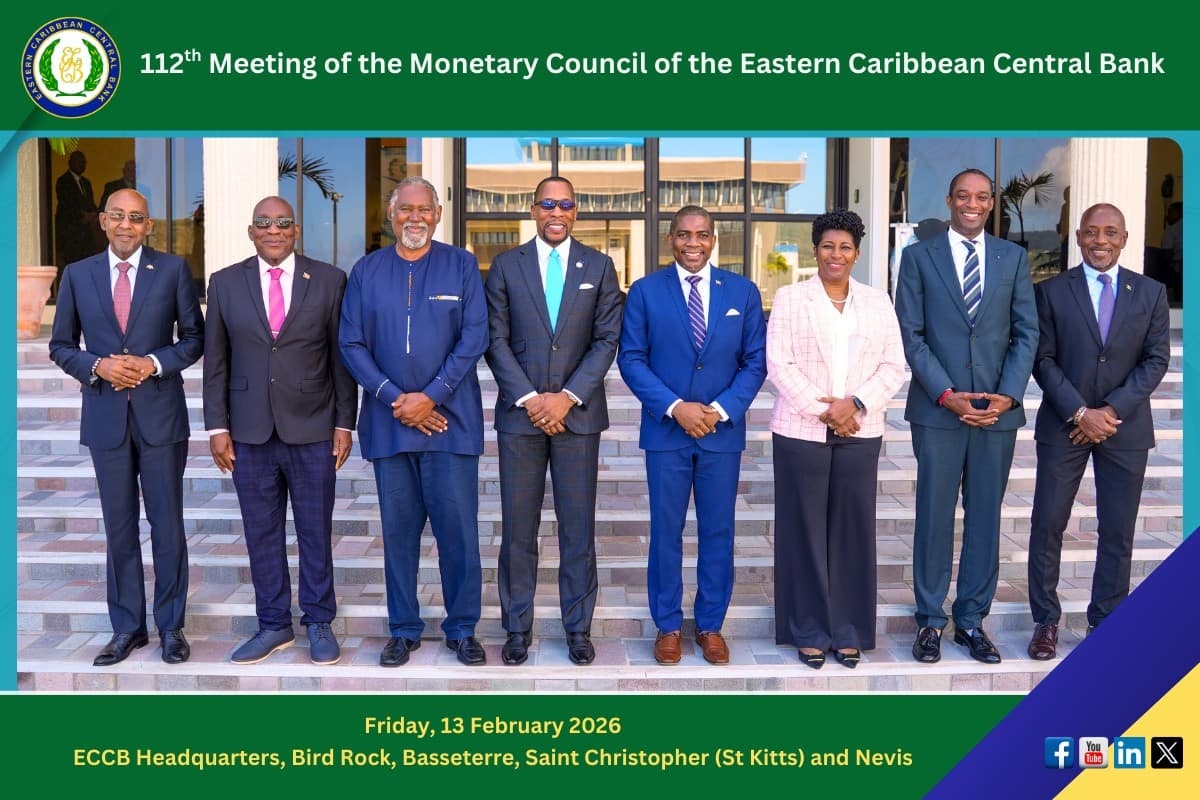
Several Eastern Caribbean Currency Union (ECCU) member states are struggling to achieve the regionally mandated debt-to-GDP target of 60% by 2035, according to disclosures from the Eastern Caribbean Central Bank’s Monetary Council. The revelation emerged from the 112th council meeting held February 13, 2026, at the ECCB headquarters in St. Kitts and Nevis.
ECCB Governor Timothy N.J. Antoine confirmed that while some members are progressing satisfactorily toward the fiscal benchmark, others are significantly off track, with current debt ratios ranging from 6% to 100% across the eight-nation monetary union. The council’s communique explicitly noted that ‘some member countries are not on track to secure the debt-to-GDP ratio of 60% by 2035,’ despite ongoing governmental efforts to enhance fiscal sustainability.
The timeline extension from 2030 to 2035 was initially granted during the pandemic, which Governor Antoine characterized as a ‘one in 100 year event’ requiring substantial economic adjustment periods. However, subsequent challenges including global inflation, the 2021 volcanic eruptions in St. Vincent and the Grenadines, and recurring hurricane events have further complicated debt reduction efforts.
Governor Antoine emphasized that debt-to-GDP remains a ‘key metric’ for the monetary union, serving as a crucial anchor for economic stability. While not identifying specific underperforming nations, he acknowledged the ‘difficult environment’ where external shocks persistently disrupt fiscal consolidation initiatives.
The Monetary Council has advocated for implementing fiscal resilience frameworks that establish clear rules guiding countries toward debt targets. These frameworks require disciplined annual budgeting approaches, including debt-reducing balances and primary surpluses. Antoine described this process as a ‘work in progress’ essential for building fiscal space that enables crisis response without compromising long-term objectives.
Despite debt concerns, the council reported strong underlying monetary fundamentals. The EC dollar maintains exceptional strength with a 99.5% backing ratio—significantly exceeding the 60% statutory minimum—and foreign reserves totaling EC$5.83 billion, indicating robust macroeconomic stability within the currency union.