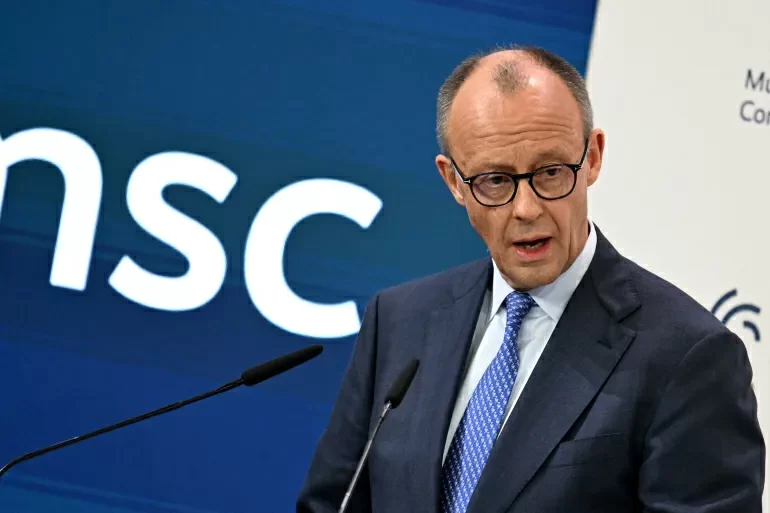
German Chancellor Friedrich Merz delivered a stark assessment of the international order during his address at the 62nd Munich Security Conference, declaring that the rules-based global system that has underpinned international cooperation since the Cold War “no longer exists in its previous form.”
Speaking before approximately fifty world leaders, Merz highlighted the “profound divide” emerging between Europe and the United States, emphasizing that European freedoms cannot be taken for granted in this new era of great power politics. “We must be prepared to make sacrifices,” the Chancellor stated during his keynote speech.
The conference convened amidst escalating tensions within the trans-Atlantic alliance, particularly following controversial statements by President Donald Trump regarding the potential annexation of Greenland, a territory of the Kingdom of Denmark. Trump’s assertion that “Greenland wants us… We’re currently negotiating for Greenland” has significantly strained diplomatic relations between European nations and their traditional American allies.
Further complicating matters, the United States has imposed new tariffs on European countries, which Merz characterized as fundamentally incompatible with Europe’s commitment to free trade principles. The Chancellor noted that the cultural conflict inherent in the “Make America Great Again” movement contradicts core European values regarding freedom of expression and human rights.
Despite these mounting challenges, Merz advocated for rebuilding trans-Atlantic trust while revealing ongoing confidential discussions with French President Emmanuel Macron about developing a joint European nuclear deterrent. This proposal marks a potential seismic shift in European defense policy, which has historically relied on American nuclear protection through NATO frameworks.
President Macron reinforced this strategic pivot by urging Europe to transform into a genuine geopolitical power. He called for accelerated military development and enhanced continental cooperation, particularly in response to the Ukraine conflict, which he described as an “existential challenge” for Europe.
U.S. Secretary of State Marco Rubio addressed the conference by acknowledging a “new era in geopolitics” characterized by rapid global transformation. Rubio confirmed that the United States is prepared to reassess its role and relationships with European partners.
The ongoing tensions between the U.S. and Denmark intensified following Trump’s unsubstantiated claims about Russian and Chinese military presence around Greenland. Danish Prime Minister Mette Frederiksen indicated her intention to discuss the American “threat” regarding Greenland, a fellow NATO member, with Secretary Rubio.
This year’s Munich Security Conference focused primarily on European defense capabilities, trans-Atlantic relations, and the geopolitical ramifications of conflicts in Ukraine and rising West-China tensions. These developments collectively signal a fundamental restructuring of global power dynamics and the urgent need to redefine international cooperation within an increasingly fragmented geopolitical landscape.