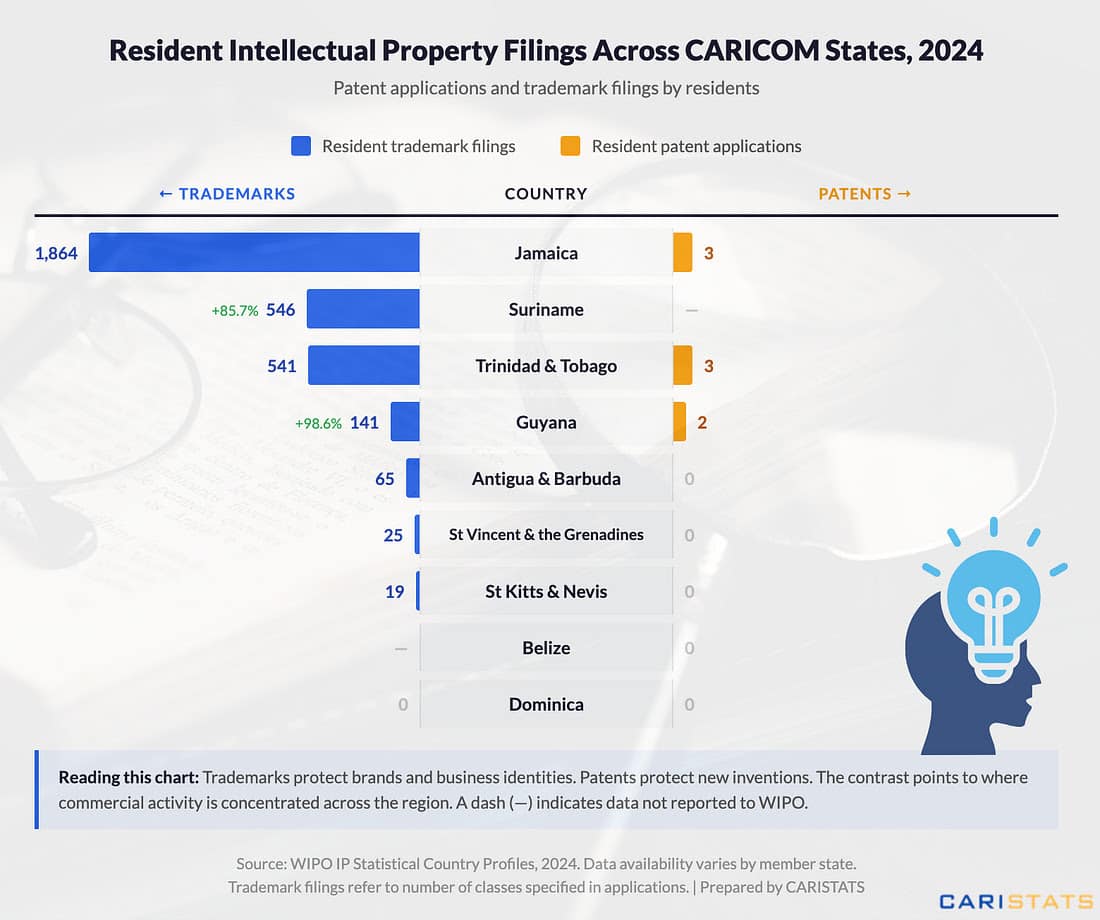
A stark intellectual property (IP) imbalance is emerging across the Caribbean Community (CARICOM), revealing a regional economic strategy heavily skewed towards branding over foundational innovation. Recent analyses of regional IP filings indicate a marketplace bustling with trademark applications for goods and services, yet one that is critically deficient in the patents that signal technological advancement and homegrown research.
Statistical data paints a concerning picture: while thousands of trademarks are registered annually by both local entrepreneurs and international corporations seeking market presence, the number of patents filed by CARICOM nationals remains exceptionally low. This trend suggests that the region’s economic players are prioritizing immediate commercial identity and consumer market protection over long-term investments in research and development (R&D) and complex technological invention.
Experts point to multiple structural factors driving this disparity. The process of securing a patent is notoriously more arduous, expensive, and time-consuming than registering a trademark, posing a significant barrier for individual inventors and small and medium-sized enterprises (SMEs) within CARICOM member states. Furthermore, a comparative lack of robust national and regional infrastructure for scientific R&D, coupled with brain drain in STEM fields, creates an environment where groundbreaking inventions are less likely to originate.
The implications of this IP dichotomy are profound for the future economic resilience of the Caribbean. A heavy reliance on trademarks indicates an economy focused on commerce and distribution, potentially leaving it vulnerable as a net consumer—rather than a producer—of high-value, patented technology. This pattern could hinder sustainable development, limit competitiveness in global knowledge-based industries, and perpetuate dependency on foreign innovation and imports.
To counter this trend, policy analysts are urging CARICOM governments and regional bodies to implement decisive measures. Proposed solutions include enhancing financial and technical support for local inventors, reforming patent registration procedures to reduce bureaucratic hurdles, and forging stronger collaborations between academia and industry to stimulate a culture of homegrown technological creation and protectable invention.