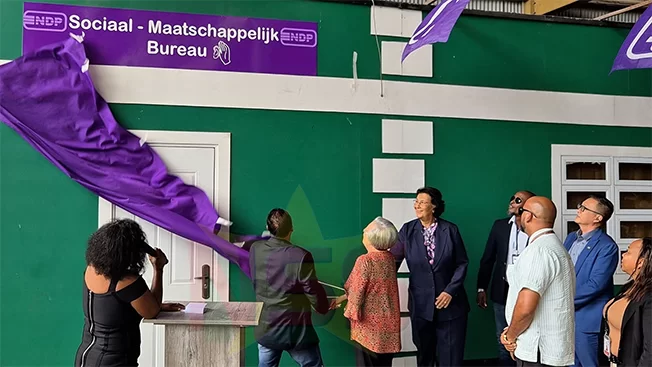
In a significant move to strengthen community support mechanisms, Suriname’s National Democratic Party (NDP) has officially reopened its Social and Societal Bureau (SMB) after a five-year suspension. The new facility, located on Hoogestraat within the former party headquarters of the BVD, was inaugurated by NDP Chairwoman and President Jennifer Simons on February 12th.
The bureau, operating under the Office of the NDP Chairman, will serve as a specialized center addressing public grievances that cannot be directly resolved through ministers, assembly members, or other government officials. Coordinator Yvonne Cheuk Alam explained that the facility will provide guidance and collaboratively seek solutions with citizens, potentially through engagement with relevant ministries depending on each situation’s specific circumstances.
President Simons emphasized the bureau’s advisory nature during the unveiling ceremony, clarifying that it does not represent an institution where individuals can obtain everything they request. Rather, it functions as an information and guidance center within a nation where many administrative processes remain unclear and assistance doesn’t always arrive promptly. The SMB specifically will not replace existing institutions but will serve as a referral and advisory point, particularly for cases requiring immediate intervention.
Cheuk Alam revealed that the bureau reactivation follows the successful operation of a similar office called the Ombudsman’s Bureau from 2010 to 2020 at the Ocer party center. That previous initiative proved effective through established agreements with ministers and assembly members, creating shorter pathways to problem resolution for citizens. The current reactivation responds to what officials describe as the dual responsibilities burdening administrators following the NDP’s assumption of national leadership under challenging circumstances.
The bureau will address multiple societal issues including land matters, housing concerns, sexual assault cases, domestic violence incidents, educational challenges, and parent-school conflicts. While primarily established to serve party members, Cheuk Alam stressed that the facility remains open to all Surinamese citizens, emphasizing national unity beyond political affiliations in the post-election period.