Bangladesh embarked on a landmark electoral process on Thursday, conducting what analysts describe as the most significant democratic exercise in its recent history. This election represents a crucial turning point for the nation of 175 million people, following the dramatic ouster of long-serving Prime Minister Sheikh Hasina in August 2024 through a youth-led uprising.
The political transformation, spearheaded primarily by Generation Z activists (those born roughly between 1997 and 2012), has reshaped Bangladesh’s political landscape. The protests that precipitated Hasina’s downfall, characterized by widespread civil unrest and occasional violence, severely disrupted vital economic sectors including the nation’s garment industry—the world’s second-largest exporter of clothing merchandise.
This electoral event marks the world’s first national election following a successful youth-driven revolution, a development that political observers believe could influence similar movements globally, with Nepal scheduled to undergo its own political transition next month.
The electoral contest features an unprecedented diversity of participation with over 2,000 candidates competing for 300 parliamentary seats, including numerous independent contenders. A record-breaking 50 political parties are participating in the democratic process, a stark contrast to previous elections marred by boycotts and intimidation tactics.
At the center of the political battle are two major coalitions: the Bangladesh Nationalist Party (BNP) and an Islamic alliance led by Jamaat-e-Islami, with recent polls indicating a slight advantage for the BNP. The formerly dominant Awami League of ex-Prime Minister Hasina has been officially banned from participation, while Hasina herself currently resides in exile in India. This political vacuum has potentially opened doors for increased Chinese influence amid deteriorating relations with India.
Concurrent with the parliamentary elections, citizens are participating in a constitutional referendum addressing substantial governance reforms. Proposed amendments include establishing a neutral interim government during election periods, creating a bicameral parliamentary system, enhancing female political representation, strengthening judicial independence, and implementing a two-term limit for prime ministers.
Nobel Peace Prize laureate Muhammad Yunus, who headed the interim government following Hasina’s removal, characterized this election as the constitutional manifestation of public awakening against prolonged inequality and systemic injustice.
The electoral process has been notably peaceful during the campaign period, with only isolated incidents reported. International observers have emphasized that the credibility and impartiality of the voting process, coupled with universal acceptance of the final results, remain paramount for Bangladesh’s democratic consolidation.
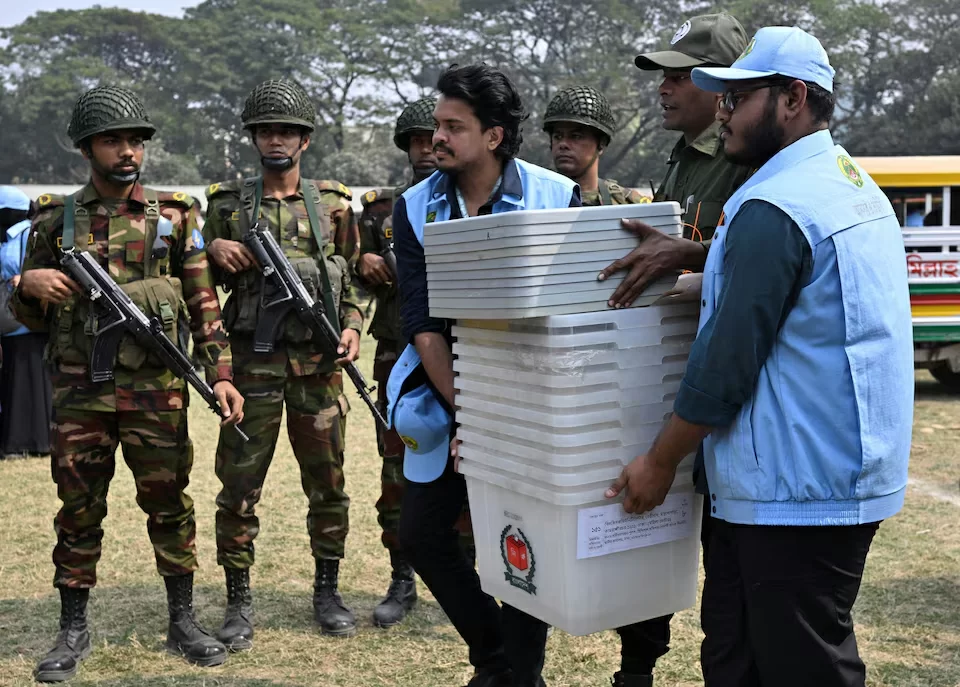
Security measures have been extensively implemented with more than 100,000 military personnel and nearly 200,000 police officers deployed nationwide to maintain order. Voting commenced at 7:30 AM local time and concluded at 4:30 PM, with preliminary results anticipated around midnight.
Among the nearly 128 million registered voters, 49% are women, though female representation among candidates remains disproportionately low with only 83 women competing for office. Voter concerns predominantly center on corruption and inflation, according to pre-election surveys.
While some voters expressed hesitation about participation due to practical constraints or disappointment over the exclusion of Hasina’s party, others demonstrated determined commitment to cast their ballots, recognizing this election’s unique significance following years of political suppression.
This electoral event represents a critical milestone in Bangladesh’s democratic renewal, conducted under intense scrutiny from domestic stakeholders and international monitors. The outcome will fundamentally shape the nation’s trajectory following a period of remarkable political transformation.