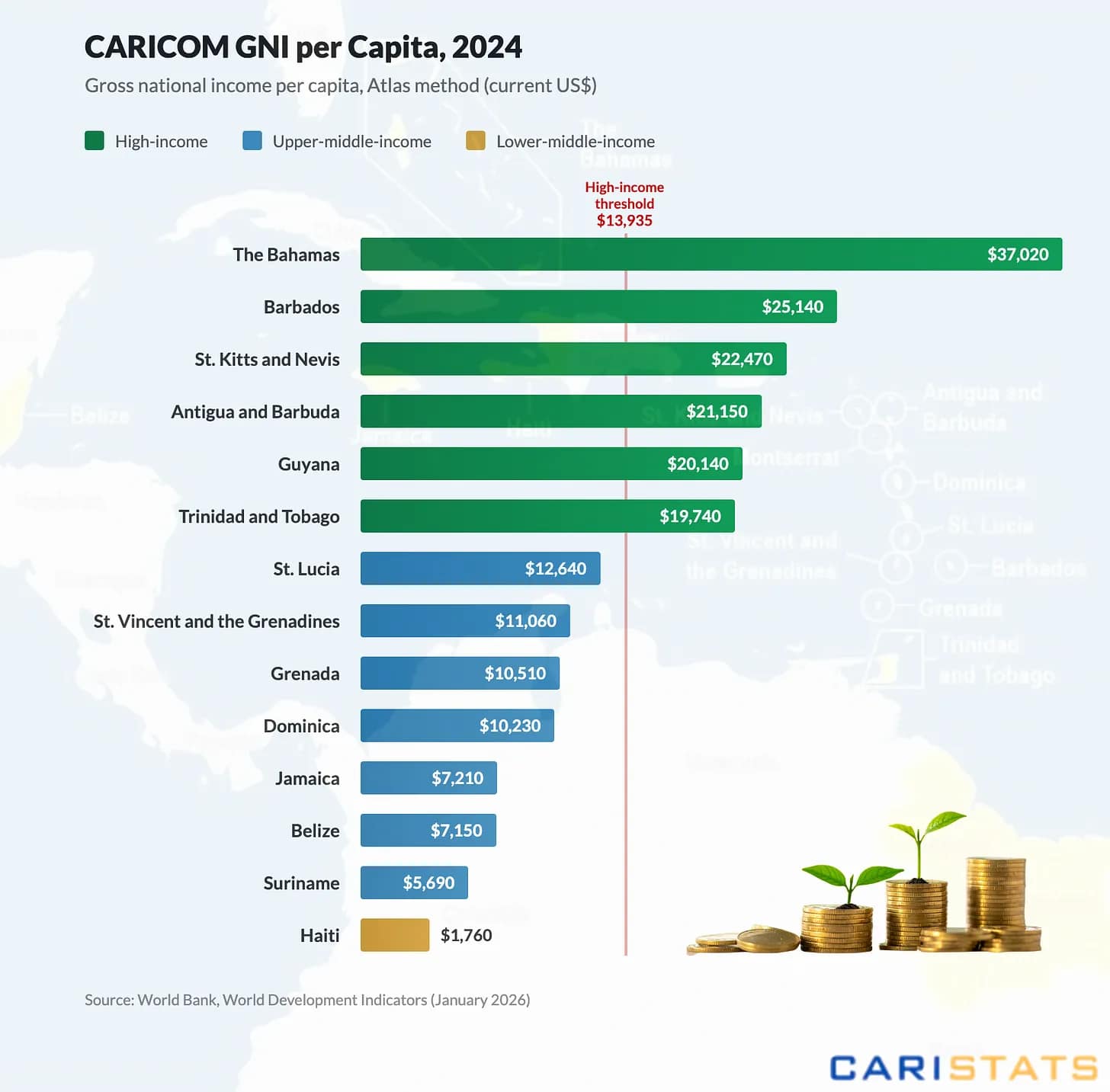
A recent analysis of economic data reveals profound income disparities across the Caribbean Community (CARICOM), with per capita GDP figures painting a picture of regional economic diversity. According to the World Bank’s World Development Indicators (January 2026), The Bahamas emerges as the regional economic leader with a substantial per capita GDP of $37,020, significantly surpassing the World Bank’s high-income threshold of $13,935.
The economic landscape shows Barbados maintaining a strong position at $25,140, followed closely by the dual-island nation of St. Kitts and Nevis at $22,470. Antigua and Barbuda recorded $21,150, while Guyana’s rapidly growing economy reached $20,140, and Trinidad and Tobago registered $19,740. These six nations collectively represent the Caribbean’s high-income economies.
Seven CARICOM members fall within the upper-middle-income category, with St. Lucia’s $12,640 positioning it nearest to crossing into high-income status. Suriname anchors the lower end of this group at $5,690, while Jamaica ($7,210) and Belize ($7,150) occupy the middle range of this economic tier.
The most striking contrast emerges with Haiti, which stands as the region’s sole lower-middle-income economy at just $1,760 per capita—the only CARICOM member state below the $5,000 mark. This vast economic chasm between The Bahamas and Haiti, representing a ratio of approximately 21:1, underscores the dramatic economic diversity within the regional bloc. The disparity highlights the varying economic foundations across the Caribbean, which encompass tourism-dependent island nations, hydrocarbon-exporting economies, and one of the Western Hemisphere’s most impoverished nations.