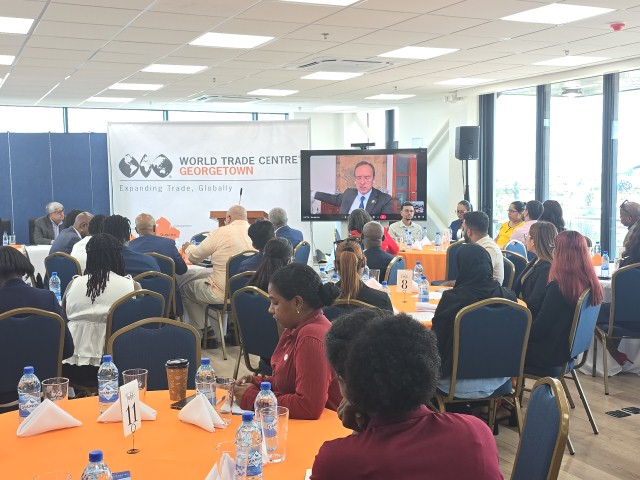
Significant diplomatic divergence has surfaced regarding the appropriate approach to Venezuela’s political and economic stabilization. Former Bolivian President Jorge Quiroga and U.S. Secretary of State Marco Rubio presented contrasting visions at a World Trade Centre Guyana forum titled ‘Perspectives on Global Trade’ this Wednesday.
Secretary Rubio emphasized that international oil companies require robust legal security and profit guarantees before returning to Venezuela. He outlined specific prerequisites: protection against asset seizure, enforceable contracts, and judicial certainty. ‘That’s the level of certainty that we’re talking about in terms of security,’ Rubio stated, noting that without these conditions, investment would naturally flow to alternative destinations like Guyana.
Rubio acknowledged recent hydrocarbon law reforms enacted within weeks of President Maduro’s removal that rolled back Chavez-era restrictions, describing them as ‘extraordinary’ though insufficient. The ultimate U.S. objective, he clarified, remains Venezuela’s transition to a ‘friendly, stable, prosperous and democratic’ nation with free elections, possibly requiring American oversight.
In stark contrast, former President Quiroga challenged the American sequencing of priorities. He argued that democracy must precede economic normalization, stating: ‘I personally think that the order that the U.S. government is talking about doing things is not quite the right order.’ Quiroga expressed skepticism that oil companies would sign agreements with ‘an interim government that is the remnants of a criminal group’ merely because of U.S. naval presence in the Caribbean.
Quiroga proposed regional diplomacy led by Latin American powers Brazil, Mexico, and Colombia to facilitate democratic transition through ministerial delegations demanding prisoner releases. He highlighted how Venezuela’s previous oil wealth ($140-150/barrel at 3.5 million barrels/day) had purchased influence through PetroCaribe and ALBA alliances, enabling human rights abuses to go unchallenged in international forums like the OAS.
The resolution of Venezuela’s crisis, Quiroga suggested, could remove toxic influences and create opportunities for renewed Caribbean-Latin American cooperation on common economic agendas and coordinated foreign policies.