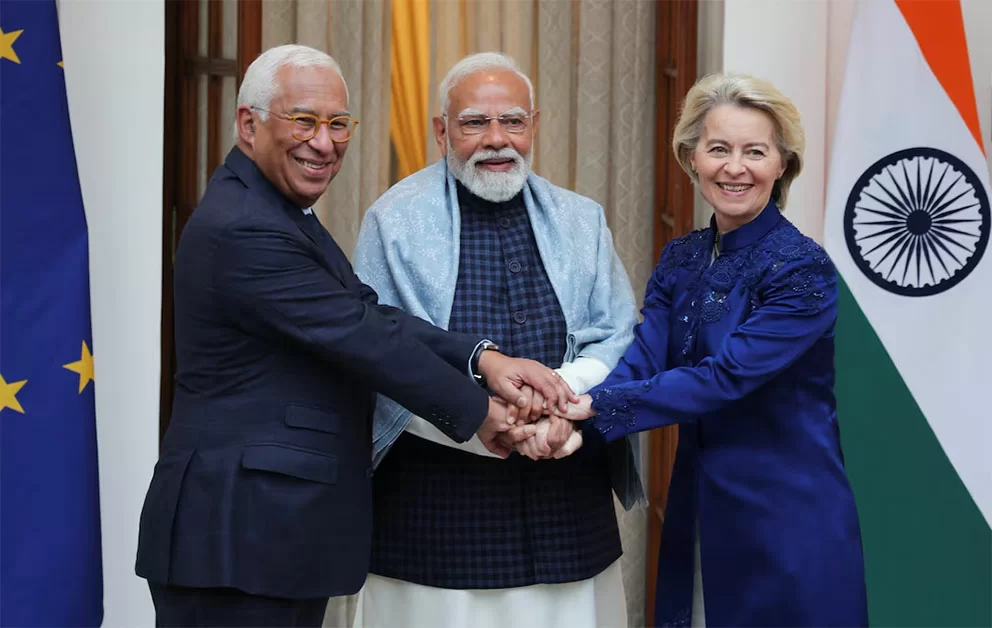
In a landmark move reshaping global trade dynamics, India and the European Union have finalized a comprehensive trade agreement after two decades of negotiations. The pact, signed at Hyderabad House in New Delhi with Indian Prime Minister Narendra Modi, European Commission President Ursula von der Leyen, and European Council President Antonio Costa in attendance, represents one of the most significant trade liberalization efforts between the major economies.
The agreement eliminates or substantially reduces tariffs on 96.6% of EU exports to India by value, projected to save European businesses approximately €4 billion ($4.75 billion) in import duties. Conversely, the EU will eliminate tariffs on 99.5% of Indian imports within a seven-year framework, covering key Indian export sectors including seafood, leather goods, textiles, chemicals, rubber, base metals, and jewelry.
Prime Minister Modi hailed the agreement as “the mother of all deals” that will “create tremendous opportunities for India’s 1.4 billion people and millions of Europeans.” European Commission President von der Leyen characterized the pact as a “historic step” and emphasized that this marks “just the beginning” of enhanced EU-India economic cooperation.
The breakthrough comes amid shifting global trade alignments, accelerated by recent U.S. imposition of 50% tariffs on certain Indian goods and broader trade tensions under the Trump administration. The agreement notably excludes several agricultural products including soybeans, beef, sugar, rice, and dairy from tariff reductions.
The pact dramatically opens protected Indian market segments, with automobile tariffs dropping from as high as 110% to 10% over five years, benefiting European manufacturers including Volkswagen, Renault, Mercedes-Benz, and BMW. Immediately upon implementation, tariffs on 250,000 vehicles annually valued above €15,000 will drop to 30-35%.
Similarly, alcohol tariffs will see substantial reductions: wine tariffs falling immediately from 150% to 75% with a gradual reduction to 20%, while spirits tariffs will drop to 40%. Additional reductions apply to European machinery, electrical equipment, chemicals, and iron and steel products.
The EU has committed to providing flexibility regarding the Carbon Border Adjustment Mechanism (CBAM), its carbon tax regime affecting steel, cement, electricity, and fertilizers effective since January 1. Additionally, the EU will provide India with €500 million in financial support over the next two years to reduce greenhouse gas emissions.
Bilateral trade between India and the EU reached $136.5 billion in the fiscal year ending March 2025, slightly exceeding India’s trade with both the United States ($132 billion) and China ($128 billion). The agreement is expected to double EU exports to India by 2032.
Following a five-to-six month legal review period, full implementation of the agreement is anticipated within one year, marking a significant reconfiguration of global trade partnerships during a period of increasing geopolitical realignment.