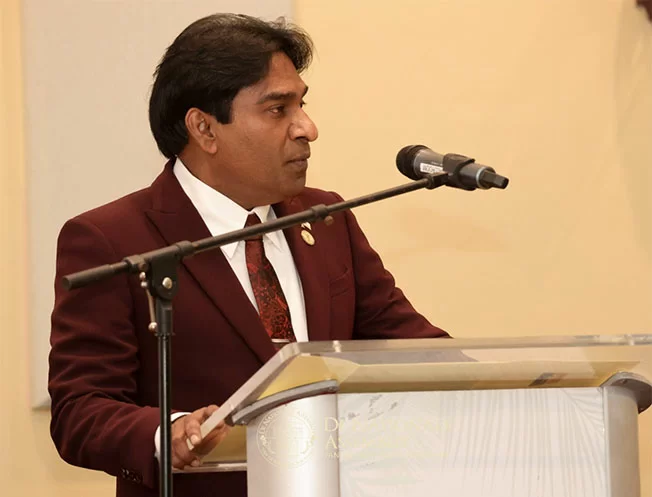
Suriname’s judicial system stands at a historic crossroads requiring fundamental decisions that will shape legal proceedings for current and future generations, according to President of the Court of Justice Iwan Rasoelbaks. Speaking at the Judicial Modernization Congress on Thursday, Rasoelbaks emphasized that the nation’s court modernization represents not a sudden initiative but the culmination of years of systematic reforms, strategic investments, and institutional choices.
The judicial leader revealed that the congress emerged from a shared recognition between legislative and judicial branches that structural dialogue has become imperative. While recent legislative initiatives concerning the judiciary provided the immediate catalyst, Rasoelbaks noted that reform necessity has existed for decades. “We essentially should have held this conversation around 1975,” he observed, referencing the prolonged period during which fundamental questions about the organization of the rule of law remained unaddressed.
A significant obstacle identified by the Court President is the outdated organizational law for the judiciary, which originated in 1869 and underwent only limited revision in 1936. This antiquated legislation, according to Rasoelbaks, severely restricts operational agility, expansion capabilities, and modern administration within both judicial organizations and the Public Prosecutor’s Office. Despite these constraints, judges have consistently endeavored to deliver justice within this restrictive framework.
Rasoelbaks recalled the 2003 sit-down action by sitting magistrates, when judges suspended work for ten days to highlight the dire situation. This protest marked the beginning of a developmental trajectory that has since been implemented incrementally. Capacity building emerged as a critical focus area, with several judicial training programs established through collaboration with the Netherlands Council for the Judiciary.
Since 2003, five specialized RAIO training programs have produced 31 new judges. Rasoelbaks stressed that judge education constitutes an intensive and prolonged process with suitable candidates remaining scarce. “You cannot simply hand a lawyer a gavel and expect them to be a judge,” he remarked.
Beyond educational initiatives, additional measures have advanced judicial reform. In 2018, experienced legal practitioners from court practice underwent accelerated judicial training, resulting in eight appointments. Available capacity has enabled judicial decentralization to districts including Brokopondo and Marowijne, alongside existing courts in Paramaribo and Nickerie. Small claims courts have also been established to make justice more accessible to citizens.
Rasoelbaks simultaneously issued a sobering warning about future challenges. Within ten years, half of current judges will reach retirement age, with only a small core remaining within fifteen years. Continuation and expansion of training programs are therefore inevitable. “Without capacity and without resources, nothing is possible,” he emphasized.
Institutional advancements have likewise progressed. A code of conduct and complaints procedure for judges has been established, and the 2019 amendment of the Government Accounting Act redesignated the Court of Justice as an independent administrative body with its own budget. Since 2022, the court has operated with independent financial resources separate from the Ministry of Justice and Police. Legislation to further consolidate this position currently awaits parliamentary consideration.
The Court President also addressed discussions concerning establishing a third judicial instance, noting two primary options: joining the Caribbean Court of Justice or creating Suriname’s own supreme court. Regardless of the chosen path, Rasoelbaks indicated this would require careful and prolonged development, with existing first and second instance courts requiring further strengthening first.
He expressed confidence that the congress would significantly contribute to informed decision-making by competent authorities. “This is not an endpoint, but the beginning of a subsequent trajectory,” concluded Rasoelbaks, urging participants to continue dialogue in service of building a robust, modern, and future-proof legal system for Suriname.