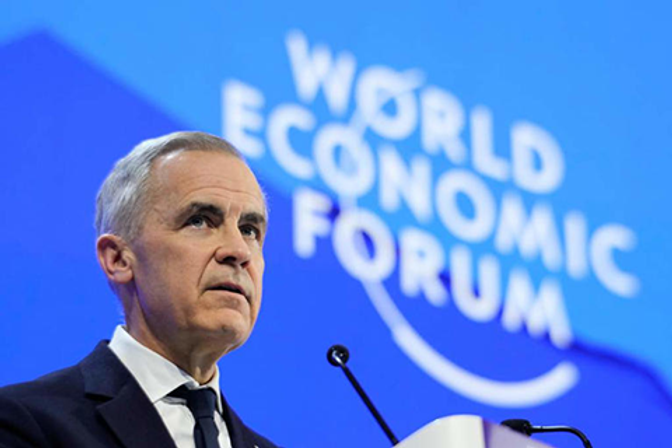
In a stark address at the World Economic Forum in Davos, Canadian Prime Minister Mark Carney delivered a sobering assessment of the contemporary international landscape, cautioning that nations excluded from power negotiations increasingly risk becoming targets of geopolitical ambition. Carney characterized the current global situation not as a transitional phase but as a fundamental rupture in the international system.
The Prime Minister articulated that the established rules-based global order has ceased functioning as intended, particularly for countries that historically depended on multilateral institutions, trade regulations, and international law to restrain the actions of dominant powers. He contended that both governments and corporations persist in operating under the pretense that the former system remains intact, despite privately acknowledging its progressive deterioration—a collective self-deception that enables power politics to proliferate without meaningful constraint.
Drawing inspiration from Václav Havel’s seminal essay ‘The Power of the Powerless,’ Carney likened the international community to Havel’s shopkeeper who displays political slogans without genuine belief merely to signal compliance. For decades, Carney argued, nations have similarly placed ‘signs in their windows’ by rhetorically endorsing a rules-based order while tacitly accepting its exceptions, hypocrisies, and selective enforcement.
This arrangement, while imperfect, previously functioned through American hegemony which provided essential global public goods including security protection, open maritime routes, financial stability, and dispute-resolution frameworks. These benefits enabled many governments to pursue value-driven policies under the assumption that a broader architectural order would persist.
Carney emphasized that this implicit bargain has now collapsed, citing growing concerns about the United States’ increasingly transactional approach toward allies and international institutions. This shift includes employing tariffs and economic threats as geopolitical leverage and demonstrating willingness to circumvent international norms when they conflict with national objectives.
The timing of Carney’s address coincided with heightened global anxiety regarding U.S. pressure on Greenland, where strategic positioning and Arctic resources have become bargaining chips in broader security competition. Carney explicitly positioned Canada in support of Greenland and Denmark’s sovereignty, warning against leveraging economic measures to advance Arctic geopolitical ambitions.