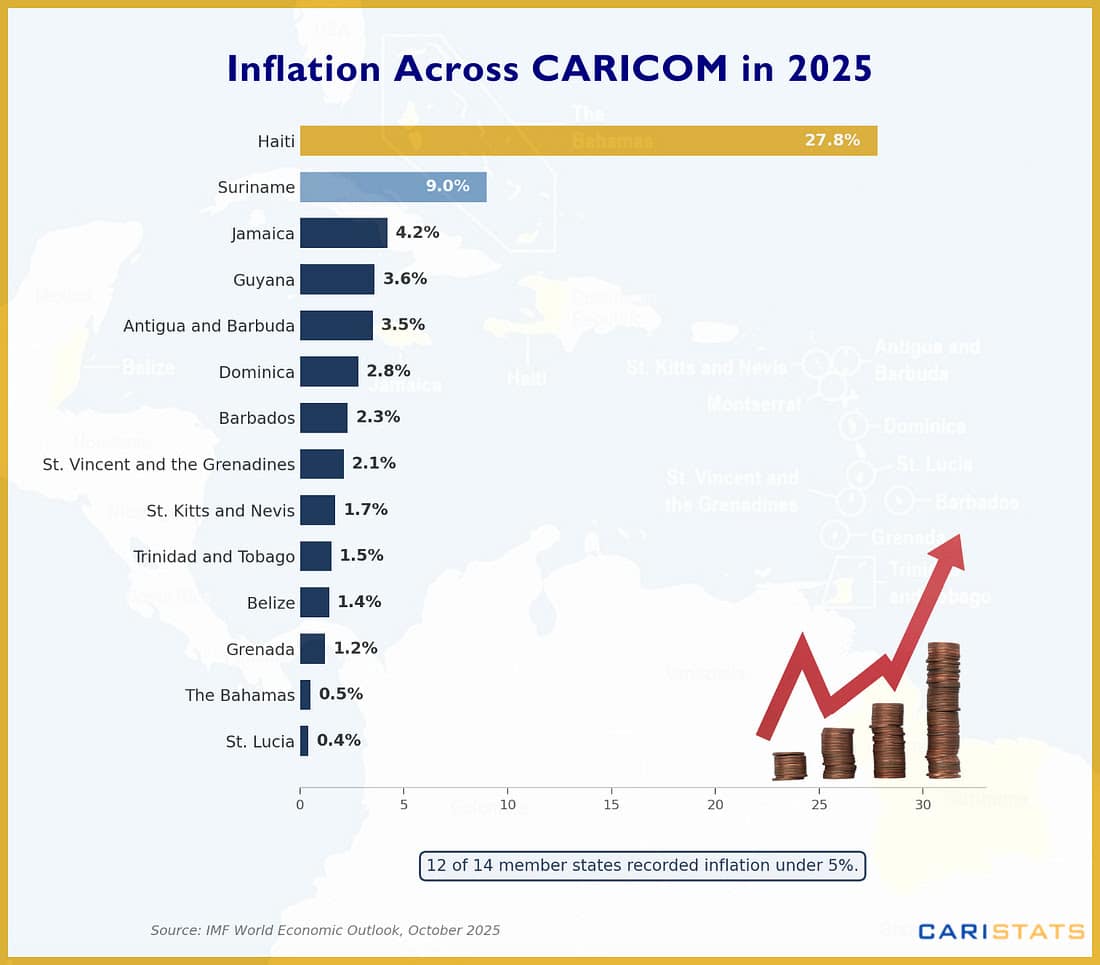
The Caribbean Community (CARICOM) demonstrated remarkable economic resilience throughout 2025 as the majority of member states successfully maintained inflation rates within manageable thresholds below 5%. This collective achievement marks a significant departure from the elevated price pressures that characterized the region in previous years.
According to the latest International Monetary Fund data from its October 2025 World Economic Outlook, price stability varied across the regional bloc with several nations achieving exceptionally low inflation. Saint Lucia emerged as the region’s top performer with a minimal 0.4% rate, closely followed by The Bahamas at 0.5%. A substantial cohort including Grenada, Belize, Trinidad and Tobago, Saint Kitts and Nevis, and Saint Vincent and the Grenadines all maintained inflation comfortably below the 2.5% benchmark.
The middle tier of inflation performance featured Barbados (2.3%), Dominica (2.8%), Antigua and Barbuda (3.5%), and Guyana (3.6%). Jamaica registered a moderate 4.2% rate, still within the sub-5% stability threshold that characterized most of the community.
Notable exceptions persisted at the upper spectrum, with Suriname reporting 9% inflation—a figure that, while elevated, represents dramatic improvement from the catastrophic 50%+ hyperinflation experienced during the 2021-2022 period. Haiti continued to face extreme economic challenges with inflation soaring to 27.8%, directly reflecting the nation’s protracted political crisis and severe humanitarian emergency.
For both consumers and enterprises operating throughout the Caribbean basin, these indicators signal a substantial return to relative price normalcy. The current stability contrasts sharply with the 2022 economic landscape when multiple CARICOM economies documented inflation rates two to three times higher than present levels, demonstrating considerable progress in monetary policy effectiveness and economic management across the region.