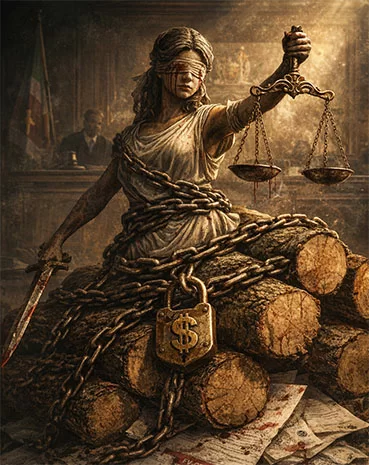
A disturbing legal drama unfolds in Suriname as the state stands accused of institutionalizing document fraud within its timber export certification system. What began as routine administrative procedures has escalated into a criminal conspiracy with judicial complicity, revealing systemic corruption that threatens the foundation of the country’s rule of law.
The case centers on phytosanitary certificates—internationally recognized documents intended to verify the authenticity of exported timber. Surinamese courts have compelled state officials to knowingly issue false certifications, deliberately mislabeling expensive wood species as cheaper Mora timber to facilitate illegal exports to India. During court proceedings, it was explicitly acknowledged that accurate labeling would prevent these exports, yet judges proceeded to mandate the fraudulent documentation regardless.
State Attorney Diepak Jairam delivered the unequivocal verdict: “The court has condemned Suriname to commit a criminal act that legally constitutes an offense.” This represents not mere policy disagreement but conscious falsification of official records with judicial oversight.
Parallel to these civil proceedings, the Ministry of Agriculture, Livestock and Fisheries (LVV) attempted to file criminal complaints against former officials who signed the fraudulent certificates. These complaints were systematically rejected as “too politically sensitive,” while authorities accepted only one complaint against a timber company—not among the six exporters the state had originally brought to court.
The institutional failure extends across multiple branches of government. Prosecutors refuse to investigate potential document forgery within state institutions, demonstrating what observers characterize as “selective blindness”—a condition fatal to any constitutional democracy.
Legal experts note that fundamental principles of proper governance cease where crimes begin. When criminal acts occur, there should be no balancing of interests, no rationality test—only immediate cessation. Yet Suriname’s institutions appear to have normalized the concept that long-standing errors acquire continuation rights, that economic damage outweighs criminal justice, and that courts may compel actions they themselves recognize as unlawful.
This case has transcended its origins as a timber dispute to become a thriller about pressure, fear, and institutional failure—a story where judges, prosecutors, and officials remain trapped in a construct nobody dares to stop. The fundamental question now facing Suriname’s democracy: who will finally declare that this ends here?