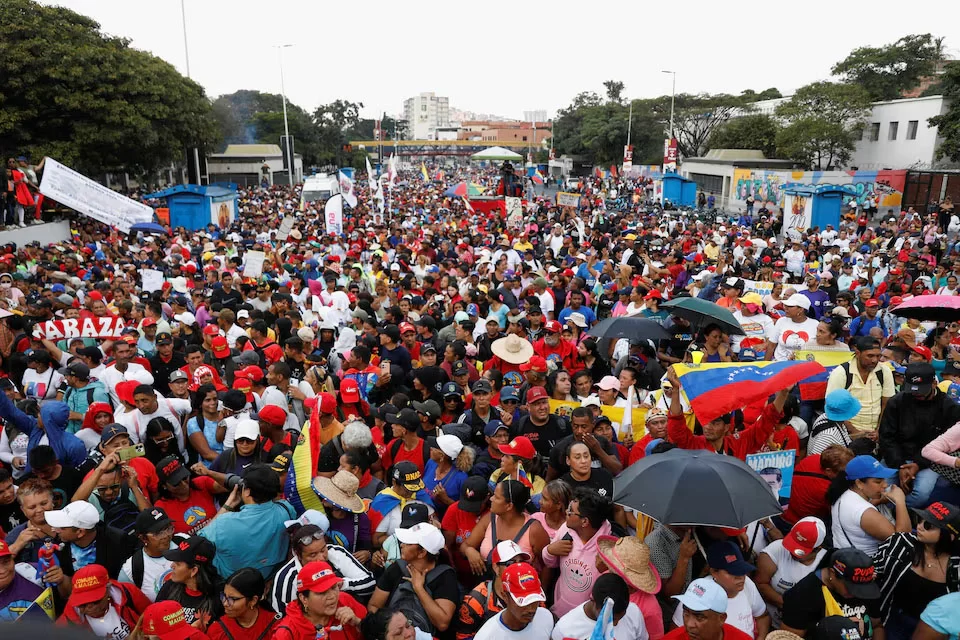
In a significant bipartisan move, the U.S. Senate has advanced measures to curtail President Trump’s military authority regarding Venezuela. The procedural vote of 52-47 saw several Republicans joining Democrats to consider a resolution prohibiting further military deployment without congressional approval.
This development coincides with Venezuela’s announcement of releasing a substantial number of political prisoners—both Venezuelan and foreign nationals—on Thursday. Jorge Rodríguez, a leading Venezuelan politician, described this as a unilateral peace gesture, addressing a long-standing opposition demand. However, human rights organizations emphasize that hundreds remain detained, with local monitoring group Foro Penal documenting 863 political prisoners including leaders, activists, and journalists.
President Trump, expressing surprise at the Senate vote, criticized supporting senators for ‘diminishing presidential power to protect the United States.’ Meanwhile, in a New York Times interview, Trump indicated U.S. control over Venezuela and regulation of oil revenues could extend ‘well beyond a year,’ discussing rebuilding Venezuela ‘in a very profitable manner.’ He noted his relationship with interim President Delcy Rodríguez, an ally of deposed leader Nicolás Maduro, was ‘very good.’
On the regional front, Trump’s stance toward Colombia appears softening. Following previous tensions, he invited President Gustavo Petro to Washington after a telephone conversation described as ‘a great honor’ by Trump, who praised Petro’s diplomatic tone.
Economically, Trump announced plans Tuesday to refine and sell up to 50 million barrels of Venezuelan oil currently under U.S. blockade. Venezuela possesses the world’s largest proven oil reserves yet suffers a profound economic and humanitarian crisis that has driven millions to flee. The White House has scheduled a Friday meeting between Trump and executives from ExxonMobil, ConocoPhillips, and Chevron—companies with Venezuelan experience—to discuss increasing the country’s oil production, though none have yet commented.
The resolution faces legislative challenges requiring House approval and a two-thirds majority in both chambers to override any presidential veto. Nevertheless, it represents rare Republican resistance to White House policy as Venezuela’s complex situation continues evolving with rapid political, military, and economic developments.