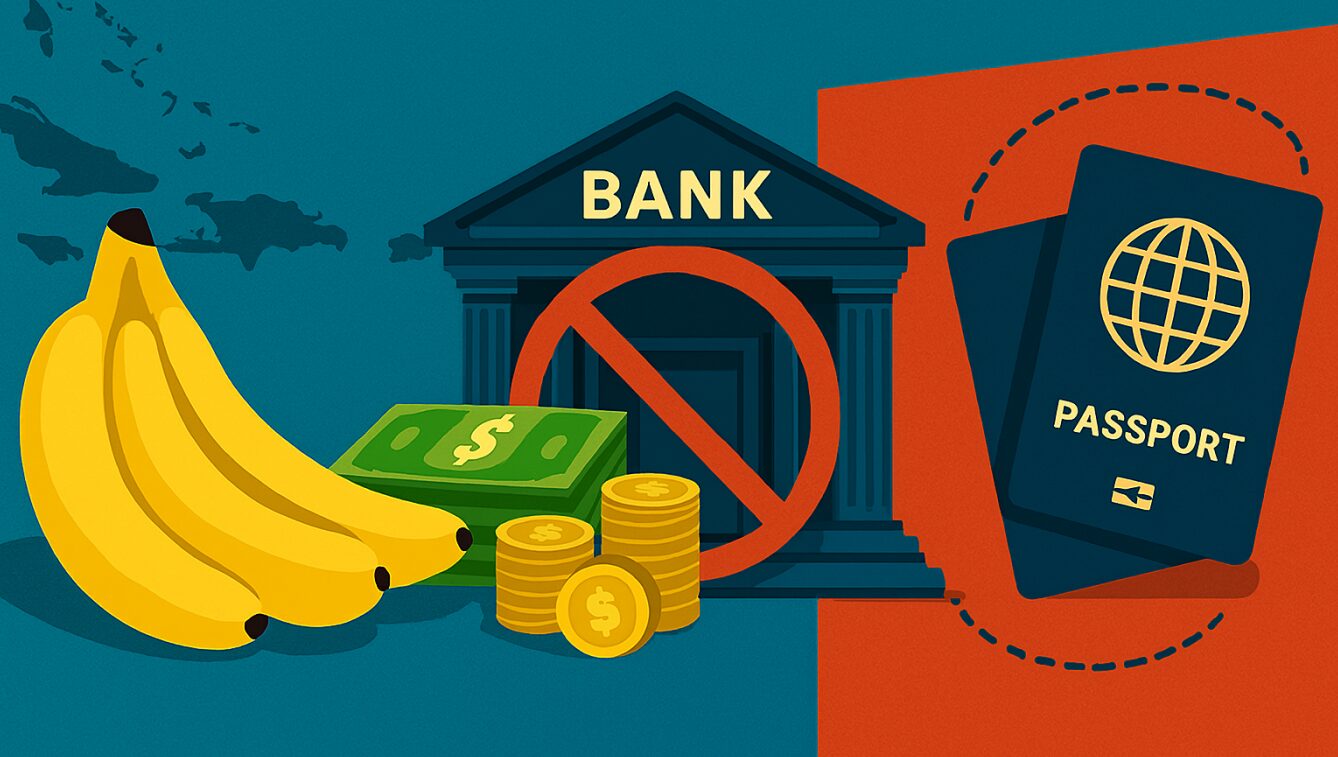
Caribbean nations are confronting what analysts identify as a recurrent pattern of economic marginalization as Western powers intensify pressure on Citizenship by Investment (CBI) programs. This development represents the latest episode in a decades-long cycle where small island states face systematic disqualification of their economic strategies.
The historical precedent dates to the 1990s Banana Preference Crisis, when Caribbean economies lost protected EU market access following WTO intervention by the United States. Small-scale farmers were compelled to compete against industrial agribusiness conglomerates, resulting in catastrophic export collapse across Dominica, St. Lucia, and neighboring islands. The episode established a troubling pattern: global rules applying uniformly in theory but asymmetrically in impact.
A parallel scenario emerged during the offshore banking era of the 2000s-2010s. Caribbean jurisdictions implementing internationally compliant financial services faced aggressive de-risking practices, FATCA enforcement, and OECD blacklisting. Correspondent banking relationships vital for economic survival were severed without individualized risk assessments, while Western financial centers like Delaware and Luxembourg maintained opaque structures with minimal scrutiny.
The current CBI confrontation reveals identical characteristics. The European Commission’s 2025 Visa Suspension Mechanism explicitly targets the very existence of CBI programs, while the U.S. Presidential Proclamation of December 2025 imposes visa restrictions citing systemic risk rather than documented abuses. This represents a fundamental policy shift where compliance becomes insufficient and program elimination emerges as the apparent objective.
Analysts note consistent double standards throughout these episodes. While restricting Caribbean development tools, Western nations continue operating their own economic residence schemes and offshore financial services. The structural asymmetry demonstrates how revenue streams permissible for major powers become classified as threats when utilized by small states.
The emerging policy environment operates through discretionary mechanisms citing national security and migration control, contrasting with the relatively predictable WTO framework that governed earlier disputes. This fluid power dynamic increasingly narrows development pathways for Caribbean nations seeking sustainable economic models.
Regional coordination through OECS and CARICOM frameworks appears essential for formulating effective responses. Experts emphasize the necessity of diversified investment strategies, shared regulatory infrastructure, and diplomatic engagement that treats Caribbean states as partners rather than risk categories. The fundamental challenge involves constructing multilateral solutions that are genuinely developmental rather than selectively punitive.
This historical perspective suggests that removing revenue streams without replacement strategies typically produces economic contraction rather than reform. The region now faces the critical task of advancing beyond reactive defense toward strategic pattern recognition and coordinated diplomacy to secure legitimate economic sovereignty.