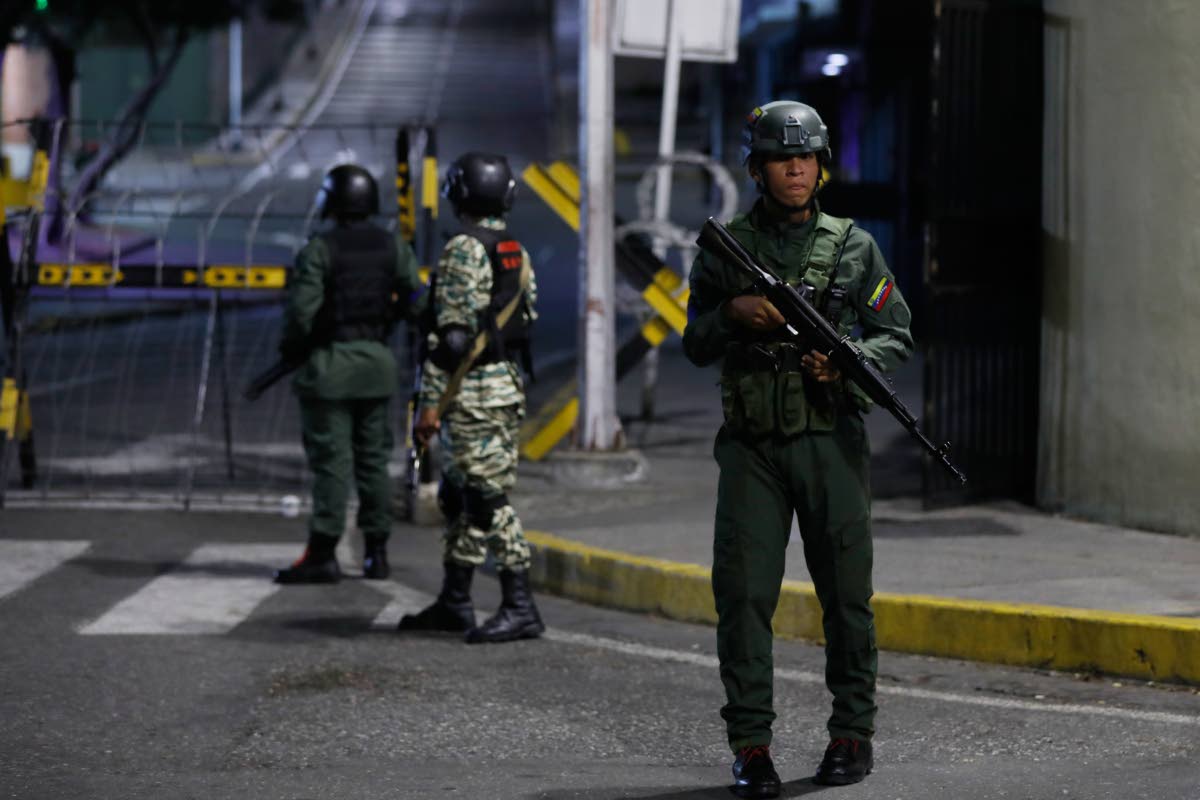
In a dramatic escalation of long-standing tensions, United States military forces executed a precision strike in Caracas, Venezuela, in the early hours of January 3rd, resulting in the capture of President Nicolas Maduro and First Lady Cilia Flores. The operation, which U.S. officials described as a surgical extraction mission, targeted a heavily fortified compound and concluded without American casualties, though one helicopter sustained damage from enemy fire.
At a subsequent news conference held at his Mar-a-Lago estate in Florida, President Donald Trump declared the United States’ intention to assume provisional control of the South American nation. He outlined plans to oversee a ‘safe, proper and judicious transition’ of power while simultaneously leveraging Venezuela’s vast oil reserves for international sale. The captured leaders were transported to the amphibious assault ship USS Iwo Jima, part of a larger U.S. naval contingent deployed to the southern Caribbean since last August, and are slated to be extradited to New York to face federal narco-terrorism conspiracy charges.
The legal foundation for the action was presented by Attorney General Pam Biondi, who unsealed a detailed indictment from the U.S. District Court for the Southern District of New York. The document characterized the Maduro administration as a ‘corrupt, illegitimate government’ sustained by a large-scale drug trafficking operation that deliberately flooded U.S. markets with cocaine.
President Trump explicitly dismissed the potential leadership of exiled opposition figure Maria Corina Machado in any interim government, citing her alleged lack of domestic support. Instead, he indicated that an American-appointed administration, involving figures such as Senator Marco Rubio, would be designated to manage Venezuelan affairs temporarily. Trump further warned that had the extraction mission failed, a larger military offensive was prepared, and affirmed a willingness to deploy ground troops to maintain order.
In response to the power vacuum, Venezuelan Vice President Delcy Rodriguez was swiftly sworn in. However, her subsequent televised address presented a starkly contradictory narrative. She vehemently denounced the U.S. incursion as an ‘atrocity’ and a violation of international law, proclaiming, ‘There is only one president in this country and his name is Nicolas Maduro.’ She stopped short of declaring herself acting president and gave no indication of cooperating with Washington, despite Trump’s claims to the contrary. The Venezuelan government declared a national emergency, with Defense Minister Vladimir Padrino López and Interior Minister Diosdado Cabello projecting defiance and urging citizens to take to the streets in defense of national sovereignty.
The international community reacted with sharp division. United Nations Secretary-General Antonio Guterres expressed ‘deep concern’ that the rules of international law were not respected, calling the events a ‘dangerous precedent.’ Conversely, Argentine President Javier Milei hailed the development as ‘excellent news for the free world.’ Condemnation was swift from leaders in Brazil, Colombia, China, and Russia, while Mexico decried a ‘clear violation’ of the U.N. Charter. Colombia reinforced its shared border to stem a potential influx of refugees, even as expatriate Venezuelans in Chile celebrated the news. The U.N. Security Council scheduled an emergency meeting to address the crisis.