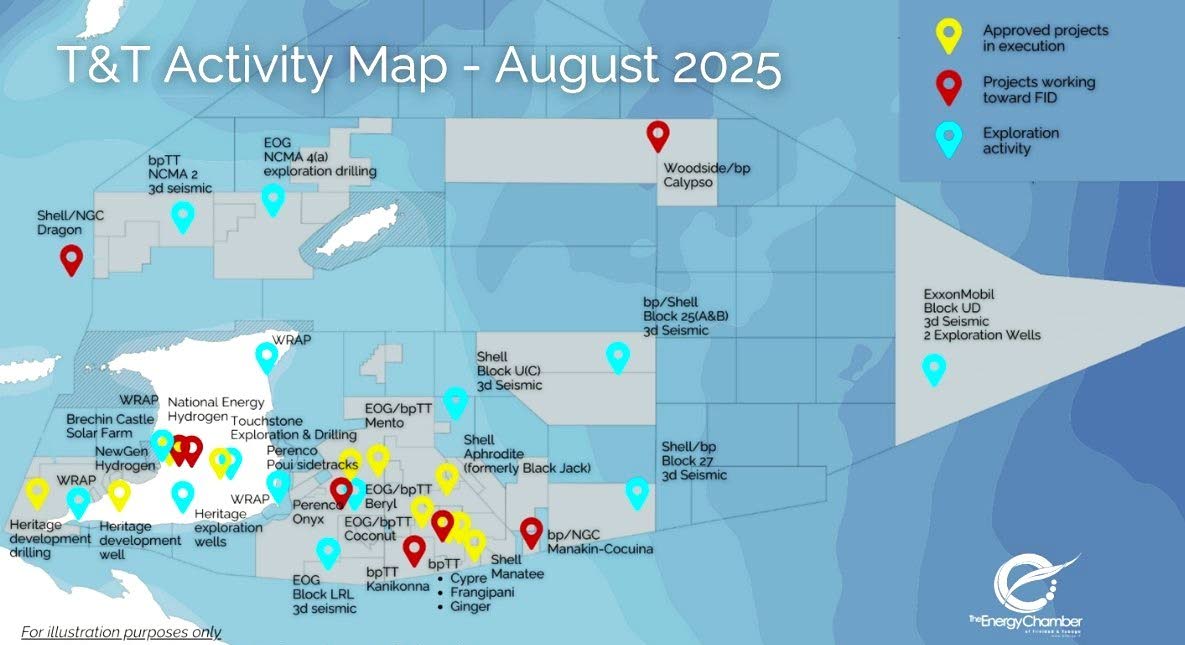
The year 2025 proved to be a period of significant volatility and unexpected developments within Trinidad and Tobago’s energy landscape, characterized by both promising advancements and substantial setbacks across upstream and downstream operations.
Upstream production metrics revealed crude oil and condensate averaging approximately 52,000 barrels per day during the first half of 2025, while natural gas production maintained 2.5 billion cubic feet per day. These figures represented a marginal oil production increase from 2024 levels alongside a slight gas production decline, according to Ministry of Energy consolidated bulletins.
Several medium-scale gas development projects achieved critical milestones, with BP, Shell, Perenco and EOG advancing initiatives including Cypre, Mento, Coconut, Ginger, Frangipani, Onyx, Kanikonna and Aphrodite. These developments are expected to mitigate production declines from mature fields. The landmark Manatee project is scheduled to commence drilling in 2026 with production anticipated by late 2027 or early 2028.
Conversely, all Venezuelan cross-border gas initiatives experienced complete stagnation. Both the Dragon and Manakin-Cocuina projects faced suspension due to geopolitical tensions between the United States and Venezuela, with concerns emerging that Manatee might similarly be affected. The critical Calypso project continued to languish without reaching Final Investment Decision, despite rumors of BP potentially assuming operatorship.
A surprising development emerged as ExxonMobil secured seven ultra-deepwater blocks through fast-tracked negotiations, theorizing that Guyana’s prolific petroleum system might extend into Trinidadian waters. Exploration activities are scheduled to commence during first-quarter 2026.
Downstream operations suffered a major blow with Nutrien’s complete shutdown of its ammonia and urea facilities, idling 600 employees amid contract disputes with National Energy, gas availability challenges, and global competitiveness pressures. Meanwhile, the new administration progressed with plans to reactivate the Petrotrin refinery through phased restart initiatives, though technical and economic feasibility questions persist.
The energy sector’s trajectory remains heavily influenced by geopolitical dynamics between the United States and Venezuela. Optimal outcomes would involve bilateral support for cross-border gas field development through Trinidadian infrastructure, potentially including utilization of flared gas from Venezuelan onshore operations. Such cooperation could unlock substantial opportunities for Trinidad’s energy services sector.
Renewable energy initiatives gained momentum with BP’s Brechin Castle solar farm achieving initial electricity generation capacity. The Ministry of Energy and National Energy received recognition for pioneering green hydrogen development, while wind resource assessment programs expanded to additional monitoring locations.
Leadership transitions across state energy enterprises including NGC, Heritage Petroleum, and National Energy introduced organizational uncertainty following the April general election. Board restructuring and executive departures raised concerns about institutional stability within these critically important energy institutions.