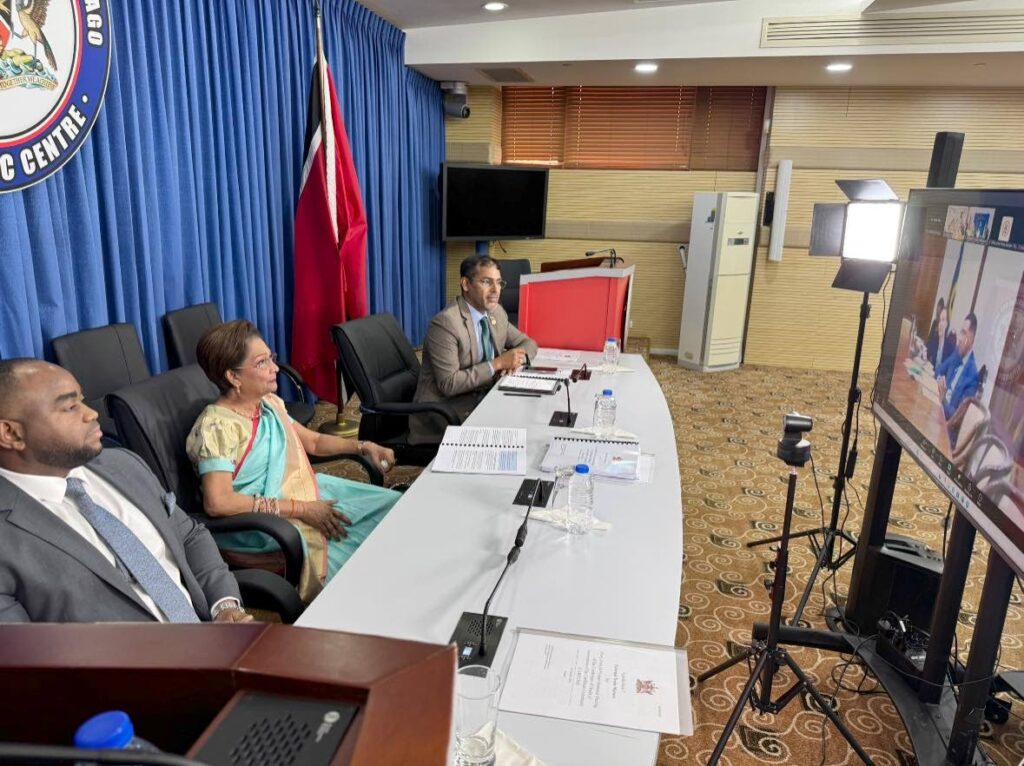
Prime Minister Kamla Persad-Bissessar of Trinidad and Tobago has dramatically intensified her criticism of the Caribbean Community (CARICOM), characterizing the regional bloc as an “unreliable partner” and condemning it as a “dysfunctional and self-destructive” organization. This sharp rebuke emerged on Monday following CARICOM’s Bureau of Conference of Heads of Government suggesting diplomatic dialogue with the U.S. government after President Trump’s decision to restrict entry for citizens from Haiti, Antigua and Barbuda, and Dominica.
The Prime Minister controversially connected this call for discussion regarding altered U.S. access for Caribbean nationals with an implicit alignment to Nicolas Maduro’s Venezuelan government. This latest denunciation significantly amplifies her previous stance of reproaching CARICOM for its insistence on maintaining the Caribbean as a zone of peace. Her accusations were notably more blunt and direct than in prior statements.
In a remarkable declaration, PM Persad-Bissessar asserted that “the organization is deteriorating rapidly due to poor management, lax accountability, factional divisions, destabilising policies, private conflicts between regional leaders and political parties, and the inappropriate meddling in the domestic politics of member states.” This criticism is particularly striking given Trinidad and Tobago’s current role as CARICOM’s lead nation on energy, security, and cricket matters.
The nation’s historical significance to CARICOM adds further weight to these comments. Trinidad and Tobago was among the original signatories to the Treaty of Chaguaramas, effectively establishing the country as the birthplace of the CARICOM concept, and most recently hosted the organization’s 50th anniversary celebrations in 2023. This represents a dramatic reversal in position that member states are reportedly struggling to assess and address appropriately.
Initial responses from regional leaders have been notably cool. Antigua and Barbuda Prime Minister Gaston Browne highlighted that Trinidad and Tobago is a major regional trade partner, with estimated earnings exceeding US$1.1 billion from CARICOM trade in 2024 alone, positioning it second only to the United States. PM Browne pointedly noted that “Trinidad and Tobago faces some of the highest levels of organised crime in the Caribbean, and regional cooperation through CARICOM security mechanisms, intelligence sharing, and coordinated law-enforcement initiatives has been an essential pillar of the response.”
Barbados’ Foreign Affairs Minister Kerrie Symmonds has called for CARICOM leaders to convene “behind closed doors” to discuss the current diplomatic tension. Referring to the “uncompromising voice” within CARICOM discussions, Minister Symmonds advocated for dialogue amid regional uncertainty, though it appears unlikely he expects Trinidad and Tobago’s Prime Minister to participate.
This development raises significant questions about regional cooperation dynamics. As the U.S. military presence in the Caribbean is ultimately temporary, analysts suggest that Trinidad and Tobago should not predicate its economic future exclusively on increasingly unpredictable U.S. government relations. The current administration’s approach has demonstrated unreliability to its closest regional trade partners, a factor that will inevitably influence future diplomatic and economic negotiations within the Caribbean community.