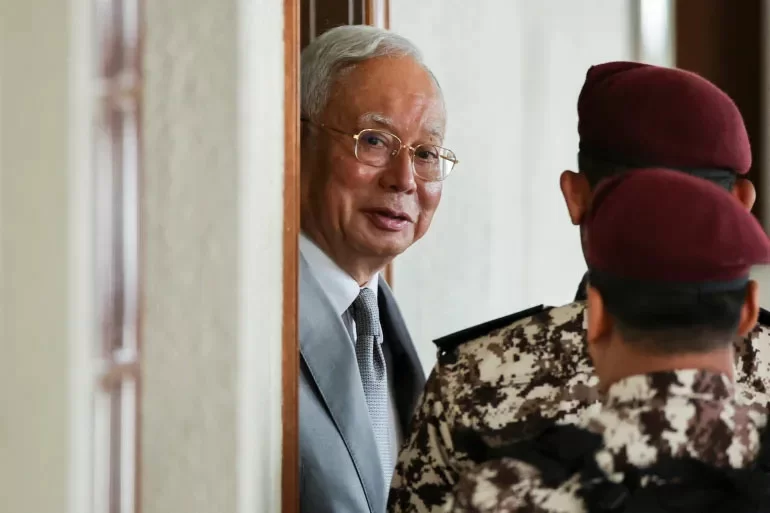
In a historic ruling that marks a significant milestone for Malaysia’s judicial system, former Prime Minister Najib Razak has been found guilty on all charges in his second major corruption trial related to the multi-billion dollar 1MDB scandal. The High Court of Kuala Lumpur delivered the verdict on Friday, convicting the 72-year-old politician on 21 counts of money laundering and 4 counts of power abuse involving the illicit transfer of 2.2 billion Malaysian ringgit ($543 million) from the state investment fund to his personal accounts.
Presiding Judge Collin Lawrence Sequerah dismissed Najib’s claims of political persecution, stating that “the defendant’s assertion that the charges against him were a witch hunt and politically motivated was refuted by cold, hard, and irrefutable evidence indicating the defendant had abused his powerful position within 1MDB, combined with the extensive powers granted to him.”
The conviction carries potential prison sentences of 15-20 years for each charge, though final sentencing remains pending. Prosecutors demonstrated how Najib exploited his roles as Prime Minister, Finance Minister, and chairman of 1MDB’s advisory board to orchestrate massive fund diversions over a decade ago.
This verdict represents Najib’s second conviction, following a 2020 ruling that sentenced him to 12 years imprisonment for misappropriating $9.9 million in 1MDB funds, later reduced to six years. The current case has been widely regarded as the most significant to date due to its direct connection to 1MDB entities and substantially larger financial amounts.
The marathon legal proceedings spanned seven years with 76 witnesses testifying, including Najib himself. Bridget Welsh, honorary research associate at the University of Nottingham’s Asia Research Institute Malaysia, noted the complexity of the case: “The trial has experienced many delays and it’s very complex to understand. These financial crimes are complex and it has been a long and extensive process.”
Despite maintaining his innocence and blaming fugitive financier Jho Low—wanted by Interpol since 2016—for misleading him, Judge Sequerah established Najib’s “undeniable connection” with Low, who served as the prime minister’s “intermediary.” The court also rejected Najib’s defense that he mistakenly believed some illicit funds were “donations” from the Saudi royal family.
The 1MDB scandal, first exposed in 2015, proved transformational for Malaysian politics, leading to the downfall of the United Malays National Organisation (UMNO) after six decades in power. Political analyst James Chai from Kuala Lumpur noted that despite the serious charges, Najib retains popularity among certain Malaysians, and his case remains a “red line” for UMNO, which currently participates in Prime Minister Anwar Ibrahim’s unity government.
Chai warned that the conviction could threaten governmental stability, potentially accelerating calls for UMNO’s withdrawal from the coalition. “While the verdict was fair and appropriate without clear shortcomings, conviction on all charges might be interpreted as ‘harsh’ by Najib supporters amid shifting political sentiments in Malaysia,” Chai observed, adding that “the anti-corruption reputation that helped bring this government to power may now become a burden.”
As the sentencing and appeal process awaits, experts emphasize that the outcome will demonstrate the strength of political accountability in Malaysia. Welsh concluded: “This is a test for the Malaysian judiciary, and it’s a test of the political will to let this continue, especially given that the involved party is also part of the government.”