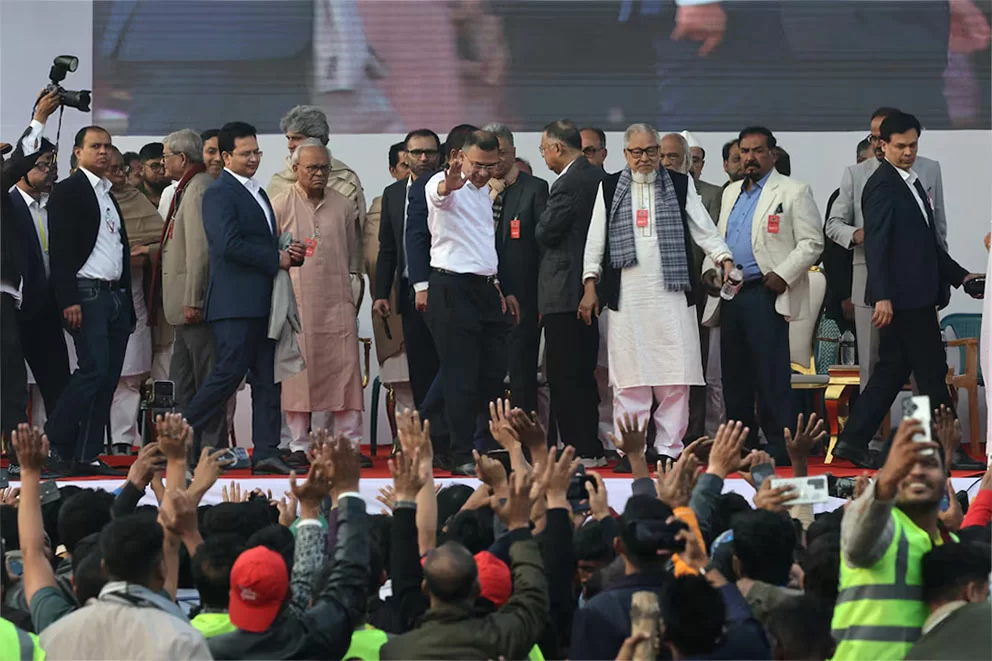
In a dramatic political homecoming, Tarique Rahman, acting chairman of the Bangladesh Nationalist Party (BNP), returned to Dhaka on Thursday following nearly 17 years of exile in London. The carefully orchestrated return marks a pivotal moment in Bangladesh’s fragile political transition as the nation prepares for February elections.
Hundreds of thousands of supporters lined the route from Dhaka airport to the reception venue, waving party flags and holding banners while high-level BNP officials welcomed Rahman under tight security. The 60-year-old son of ailing former Prime Minister Khaleda Zia made his symbolic return by removing his shoes to walk barefoot on Bengali soil and gathering a handful of earth as a gesture of homecoming.
Addressing ecstatic crowds at the reception center, Rahman opened his speech with “Beloved Bangladesh,” promising to unite people of all faiths and ensure their safety. “We will build a Bangladesh that a mother dreams of,” he declared, urging Muslims, Hindus, Buddhists and Christians to join him in creating an inclusive nation. He emphasized his vision for a democratic, economically strong Bangladesh, stating: “I have a plan – a plan for the people of my country, for my country.”
The return occurs during a sensitive electoral period in the Muslim-majority nation of nearly 175 million people, currently under an interim government led by Nobel laureate Muhammad Yunus. The elections are viewed as crucial for restoring political stability after nearly two years of turmoil. While authorities have promised free and peaceful elections, recent media attacks and sporadic violence have raised concerns about the electoral process.
Rahman’s homecoming follows the quashing of his convictions in absentia for money laundering and alleged involvement in a plot to assassinate former Prime Minister Sheikh Hasina. The legal barriers disappeared after Hasina was ousted by student protests last year. The political landscape has shifted dramatically since Hasina’s fall, ending decades where she and Khaleda largely alternated power.
The return also carries personal urgency as Rahman’s mother Khaleda has been seriously ill for months. Rahman visited her in hospital shortly after his arrival.
According to a December survey by the U.S.-based International Republican Institute, the BNP appears positioned to win the largest number of parliamentary seats, with the Islamic party Jamaat-e-Islami also remaining in contention. Hasina’s Awami League party, excluded from the February 12 elections, has threatened unrest that some fear could disrupt the voting process.
Nahid Islam, leader of the National Citizen Party that emerged from the youth protest movement that toppled Hasina, expressed hope that Rahman would help shape Bangladesh’s democratic future. “Our greatest challenge now is to create a culture of coexistence and healthy competition in the new political reality,” he stated.