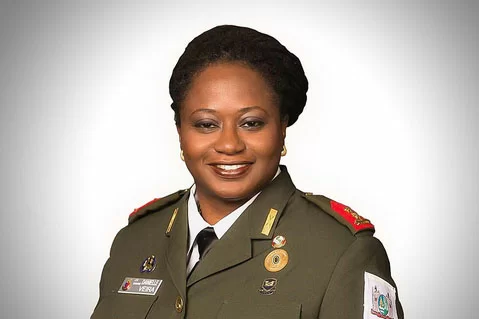
In a dramatic courtroom scene, Danielle Veira, former head of Suriname’s Directorate of National Security (DNV), delivered an emotionally charged final statement before the Military Court on Monday, vehemently denying all charges against her while decrying what she described as a systematic campaign to destroy her reputation.
The once-respected intelligence chief, known publicly as ‘Doewet’ and ‘Help Yourself’ for her efforts protecting citizens during the early COVID-19 pandemic, emotionally recounted her fall from grace. ‘In my worst nightmares, I never imagined having to defend myself here,’ Veira stated, her voice trembling with emotion. ‘I’ve been scornfully labeled as a villain and suspect despite my service to the nation.’
Veira, who made history as Suriname’s first female intelligence director, highlighted the fragility of professional reputation. ‘I was appointed based on my reliability, competence, and integrity, yet here I stand today,’ she told the court, describing her recent years as ‘going through hell’ while maintaining her faith in divine justice despite being ‘portrayed as public enemy number one.’
Addressing specific allegations regarding the Rodney Cairo hostage incident, Veira acknowledged wishing she ‘had been more alert that morning’ but maintained her decision to contact the police commissioner was intended to secure observations rather than conceal criminal activity. She revealed DNV had been monitoring Cairo for ‘considerable time’ due to indications he ‘could endanger state security.’
Veira repeatedly asserted her innocence regarding all thirteen charges brought by the Public Prosecutor’s Office (OM), suggesting she’d been targeted by ‘a plan to bring her down’ and expressing hope for ‘a justice system not driven by ego.’
Earlier in proceedings, defense attorneys raised substantive questions about prosecution inconsistencies. Lawyer Cedric Meijnaar questioned why other DNV leaders who authorized weapon permits before and after Veira’s tenure faced no prosecution, while Derrick Veira highlighted what he termed ‘numerous investigative blunders’ by prosecutors—including accepting Cairo’s statements without verification and failing to authenticate submitted evidence despite contradictions with camera footage.
With prosecutors seeking a nine-year sentence, the Military Court is scheduled to deliver its verdict next week in a case that has exposed deep tensions within Suriname’s security apparatus.