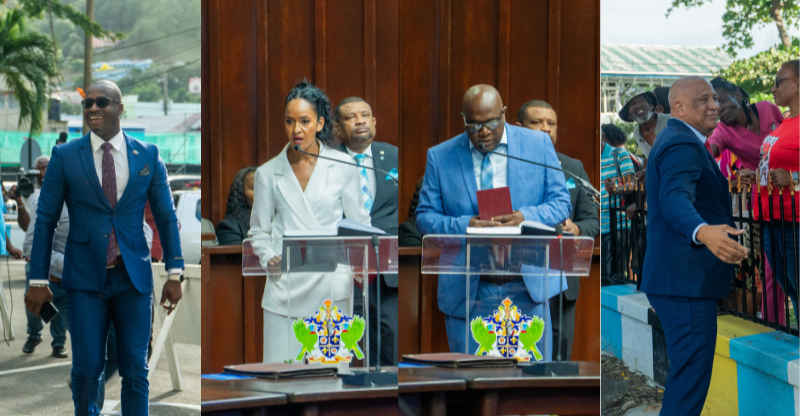
Prime Minister Philip J. Pierre’s newly unveiled Cabinet emphasizes strategic continuity rather than radical transformation, according to political analysts Rahym Augustin-Joseph and Earl Bousquet. The February 12th announcement revealed a structure where Pierre maintains control over critical portfolios including Finance, National Security, Justice, while assuming additional responsibilities for Constituency Development and People Empowerment.
Augustin-Joseph, a Rhodes scholar and political commentator, characterizes the arrangement as a clear centralization of authority within the Westminster system. “This configuration leaves no ambiguity regarding accountability,” he noted. “The Prime Minister stands at the center of governance, meaning governmental success or failure will directly correlate with his performance across these key areas.”
Veteran analyst Bousquet offered a contrasting perspective, interpreting the cabinet composition as a deliberate equilibrium between experience and innovation. He emphasized that the structure reinforces Pierre’s longstanding position that no minister possesses exclusive control over any portfolio, describing the reshuffle as demonstrating both continuity and adaptability.
The government’s economic strategy remains anchored by Dr. Ernest Hilaire, who retains Tourism and Investment while gaining Commerce oversight. This consolidation brings major agencies including Invest Saint Lucia, Export Saint Lucia, and Lucian Carnival under his unified direction. As Deputy Prime Minister, Hilaire continues shaping Saint Lucia’s global economic presence, building upon his first-term achievements in revitalizing the Saint Lucia Jazz and Arts Festival and expanding Lucian Carnival.
Augustin-Joseph highlighted the critical nature of Hilaire’s role, stating, “The administration’s fortunes are intrinsically linked to his performance, given tourism’s fundamental importance to our economy.” Bousquet concurred, noting Hilaire’s collaborative environment within cabinet ensures he won’t operate in isolation, with former Commerce Minister Emma Hippolyte remaining available for policy continuity consultation.
The cabinet maintains several experienced figures, with Stephenson King continuing as senior minister and Alva Baptiste retaining External Affairs—a decision analysts attribute to requiring steady diplomacy amid global uncertainties. Bousquet interpreted King’s reassignment from Infrastructure as reinforcing Pierre’s message that experience doesn’t guarantee entitlement, characterizing it as affirming collective responsibility rather than demotion.
Infrastructure responsibilities transition to Shawn Edward, a move Augustin-Joseph suggests addresses public concerns regarding infrastructure delivery. Education, Youth Development, Sports and Digital Transformation consolidate under Kenson Casimir, despite public debate about the expanded workload. Bousquet defended the appointment, citing Casimir’s electoral success and demonstrated resilience.
The most discussed appointment proved to be Lisa Jawahir’s elevation to Agriculture, Fisheries, Food Security and Climate Change. While critics questioned her background, Bousquet dismissed assumptions that formal training alone determines competency, noting her regional parliamentary work on food security and climate change initiatives. Her appointment marks Saint Lucia’s first female Agriculture Minister, representing broader inclusion efforts that have increased female representation in both Cabinet and Senate.
Other significant changes include Jeremiah Norbert assuming a newly created Conflict Resolution portfolio addressing crime and social cohesion concerns, while Emma Hippolyte’s expanded ministry unites equity, labour and social justice under centralized leadership. Danny Butcher joins Education with responsibility for Early Childhood, Continuing and Special Education and Digital Transformation, supporting foundational reforms.
Analysts ultimately agree this cabinet configuration prioritizes delivery above symbolism. Augustin-Joseph summarizes it as “more continuity than change,” while Bousquet characterizes it as “a forward-looking team tasked with fulfilling manifesto promises made by the SLP and its independent affiliates—a cabinet appointed to deliver not just for today, but for the future.”