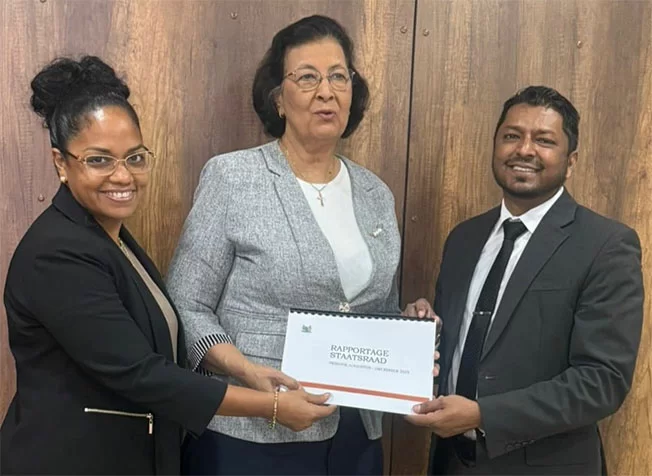
In an unprecedented move signaling governmental transparency, Suriname’s Council of State presented its inaugural written accountability report to President Jennifer Simons during Thursday’s year-end assembly. The comprehensive document chronicles the Council’s operational transformation from August through December 2025, marking a significant departure from traditional practices within this highest advisory body.
The report meticulously details the Council’s initial operational challenges upon assumption of duties, implemented corrective measures, and current operational status. Vice Chairman Amzad Abdoel revealed to StarNews that a preliminary assessment exposed critical staffing deficiencies that hampered the Council’s ability to fulfill presidential mandates. The institution lacked essential financial management personnel, operated with an understaffed secretariat, and had inadequate cleaning facilities.
Within existing budgetary constraints, the Council initiated strategic personnel reinforcement without burdening public finances. Operational workflows underwent significant optimization, resulting in enhanced efficiency. Financial management systems underwent comprehensive restructuring, with all monthly financial reports from January through September completed and submitted to the presidency. Budget utilization is now systematically monitored, outstanding payments have been reconciled, and resource allocation strategies have been optimized.
Administrative procedures have been rigorously streamlined, with correspondence to the Council now addressed within three working days. The advisory body has processed one draft law, five draft state decrees, and one legislative proposal within the four-month period, with seven new initiative proposals currently under consideration.
The Council is actively developing enhanced public accountability mechanisms, including plans for citizens to monitor proceedings online through collaboration with the E-Government Directorate. For 2026, the institution has formulated an ambitious operational plan focusing on procedural documentation, facility renovation, legislative revision, and the potential establishment of an internal audit department to further strengthen transparency frameworks.
Abdoel emphasized the report’s significance in demonstrating the Council’s transformation journey: “As a High College of State, we aim to exemplify transparency and accountability. With presidential support, we’re making substantial progress toward this objective.”