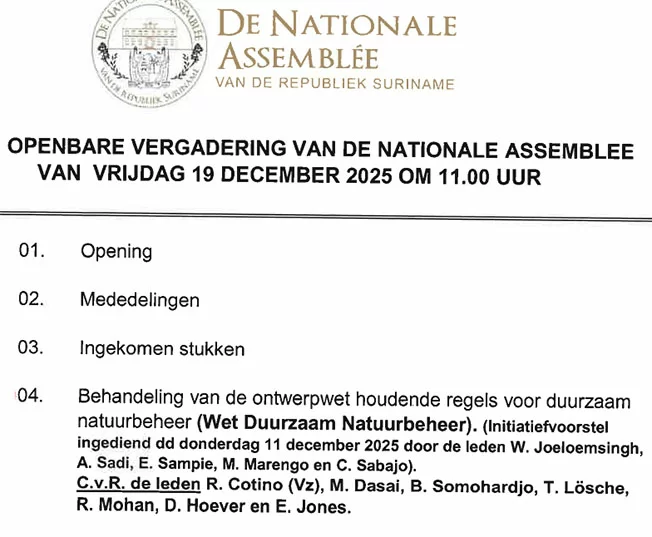
Suriname’s National Assembly is poised to conduct a pivotal public deliberation on the Sustainable Nature Management Initiative Law this Friday, marking a transformative shift in environmental governance. This legislative proceeding will commence with an administrative session featuring comprehensive reports from parliamentary committees before advancing to open debate and potential ratification.
The proposed legislation represents a fundamental paradigm shift in how the nation approaches conservation and resource utilization. With Suriname maintaining over 93% forest coverage and ranking among the world’s most biodiverse regions, the country faces critical balancing between economic development pressures and environmental preservation. The initiative constitutes a complete revision of the outdated Nature Protection Act of 1954, establishing modern frameworks for ecological stewardship.
A cornerstone innovation involves the financial architecture supporting nature policy. The legislation allocates approximately USD 20 million as seed capital for conservation management, channeled through the Environmental Fund to finance protection initiatives, sustainable usage programs, and area management. This funding mechanism extends eligibility to government agencies, local communities, and private conservationists alike, establishing unprecedented financial sustainability for environmental initiatives.
International environmental organizations including Rainforest Trust, Re:wild, and Andes Amazon Fund have committed minimum USD 20 million in conservation funding to President Jennifer Simons, contingent upon legislative modernization. These resources will strengthen protected areas, promote sustainable ecotourism, and support indigenous communities through structured programming.
Despite Suriname’s international recognition as a High Forest Low Deforestation nation, recent data reveals accelerating deforestation rates approaching 0.06% annually. Mining operations constitute the primary driver of habitat loss, followed by infrastructure development and urbanization. These trends generate not only ecological consequences but also directly impact indigenous territories, escalating land-use conflicts throughout the region.
The legislative framework explicitly embraces sustainable management principles, recognizing nature as both ecological treasure and economic resource under stringent conditions. Innovative instruments including nature tourism concessions, payments for ecosystem services, and designation of private protected areas aim to foster ‘green growth’ while reducing dependence on extractive industries like oil and gold.
Implementation authority centers on the National Environmental Authority (NMA), tasked with coordinating and executing conservation management. The NMA will oversee protected areas, concessions, scientific research, and compliance enforcement through interagency collaboration.
The legislation further institutionalizes the FPIC principle (Free, Prior and Informed Consent), mandating explicit community approval for protected areas, buffer zones, or concessions affecting indigenous territories. Traditional knowledge receives formal recognition, with provisions enabling indigenous groups to propose independently managed protected areas.