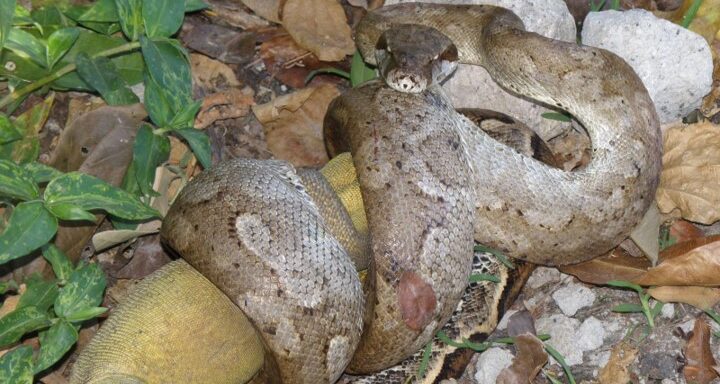
In a remarkable display of natural predation, a Dominican boa constrictor (Boa nebulosa) was documented consuming an adult iguana (Iguana delicatissima) along Elmshall Road on April 25, 2012. Wildlife observer Arl James witnessed and photographed the entire predation sequence, providing rare insight into the feeding behavior of Dominica’s largest endemic land reptile.
The encounter began when James initially mistook the iguana’s tail for roadkill before realizing he was observing an active constriction event. The boa had tightly coiled around the sub-adult iguana, employing its signature constriction technique to suffocate the prey. After approximately thirty minutes of observation, James retrieved his camera equipment and returned to document the subsequent feeding process.
The predation attracted significant attention from passersby, nearly causing traffic congestion as motorists attempted to photograph the interspecies interaction. Following the constriction phase, the snake methodically uncoiled and began dragging the lifeless iguana away from the roadway into adjacent vegetation.
The boa commenced swallowing the iguana head-first, a process researchers estimate requires approximately one hour due to the prey’s substantial size and elongated tail structure. James documented the initial swallowing phase before departing, capturing the snake having consumed the iguana up to its front limbs.
Scientific context reveals this observation contributes to understanding predator-prey dynamics between these two endemic species. Researchers from San Diego Zoo had previously documented similar predation events through skeletal remains found in 2009, where iguana skeletons were discovered inside boa skeletons, confirming head-first consumption patterns.
Both species possess significant ecological importance: The Dominican boa is a live-bearing constrictor found exclusively on the island, capable of reaching lengths exceeding 10 feet. The Lesser Antilles iguana represents Dominica’s largest lizard species, with males exceeding 3 kilograms. Recent conservation concerns have emerged due to invasive green iguana (Iguana iguana) hybridization threats to the endemic population.
This documentation provides valuable insight into the complex trophic relationships maintaining ecological balance within Dominica’s unique ecosystem, where adult iguanas serve as prey for mature boas while juvenile boas face predation from birds of prey and other predators.