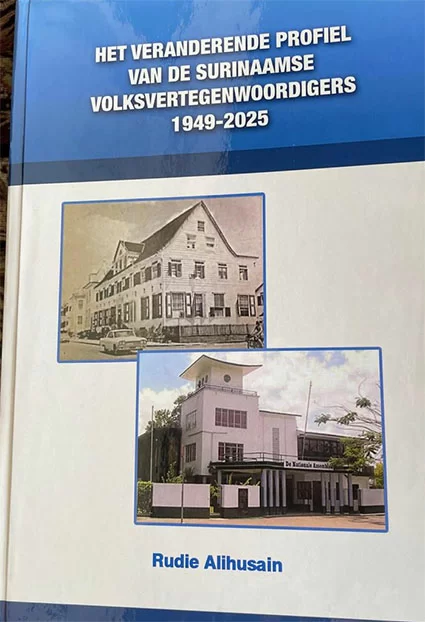
Political scientist Rudie Alihusain has expanded his seminal 2019 publication with comprehensive data from the 2020 and 2025 election cycles, creating a definitive study of Suriname’s parliamentary representation spanning 76 years. The updated work, released on December 9, 2025, offers unprecedented insights into the demographic and professional evolution of the nation’s lawmakers.
Since 1949, Suriname has conducted eighteen general elections across urban, rural, and interior regions, resulting in 735 individuals elected to parliamentary positions. The data reveals a significant gender disparity: 633 male representatives compared to 102 female representatives. Women first entered the then-Staten van Suriname in 1963, with their numbers gradually increasing to the current total.
The research identifies consistent patterns in age distribution, with the 41-50 age cohort forming the largest demographic group throughout the period, followed closely by the 51-60 age bracket. This indicates Surinamese voters’ persistent preference for candidates balancing youthfulness with experience and maturity.
Academic qualifications among representatives show that while university-educated individuals have consistently served in the National Assembly, they have never constituted a majority. Across the entire period, 236 male and 24 female academics were elected, representing approximately 35% of all parliamentarians.
Alihusain’s analysis delivers a critical assessment of intellectual engagement in Surinamese politics. Despite highly educated individuals demonstrating willingness to contribute to national development between 1949-2025, the political system has systematically failed to integrate expertise into governance structures. Professional matters frequently succumb to partisan political considerations rather than expert judgment.
The study draws compelling parallels with historical discussions in former Eastern European countries, where party leadership employed the ‘window metaphor’ – only opening to new ideas when convenient and shutting abruptly when criticism became too pointed. Alihusain identifies similar dynamics in Suriname, resulting in intellectual marginalization and withdrawal from political participation.
This expanded publication represents a monumental contribution to Suriname’s political historiography, documenting not merely who represented the nation but how political culture, social relationships, and the role of expertise have transformed across decades of democratic development.