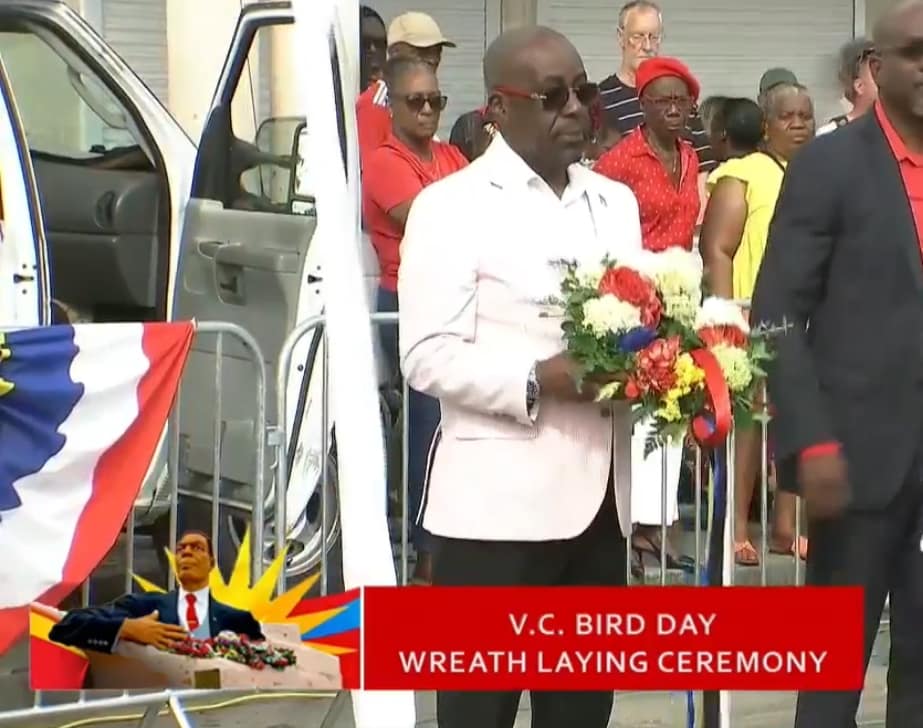
During the annual VC Bird Day commemorations in St John’s, Antigua and Barbuda’s Foreign Affairs Minister E.P. Chet Greene delivered a comprehensive tribute to the nation’s founding father, Sir Vere Cornwall Bird Sr., positioning him as both a national architect and visionary Caribbean statesman. Greene emphasized that Bird’s political philosophy extended well beyond territorial boundaries, establishing him as a pivotal force in shaping the Caribbean’s collective future through institutional cooperation.
Greene detailed how Bird’s regional integration advocacy predated Antigua’s independence, noting his instrumental role as a signatory to the CARIFTA agreement that subsequently evolved into the Caribbean Community (CARICOM). The Foreign Minister characterized Bird’s transition from West Indies Federation participant to economic agreement architect as demonstrating extraordinary foresight in recognizing that regional collaboration rather than isolation would determine the Caribbean’s destiny.
Domestically, Greene credited Bird with engineering Antigua and Barbuda’s transformation from colonial dependency to sovereign statehood. He highlighted constitutional reforms that established fundamental civil liberties and human rights protections, alongside revolutionary social programs including free secondary education and universal medical services that formed the bedrock of the nation’s social contract.
Economically, Greene emphasized Bird’s strategic pivot from sugar plantation dependence to tourism-oriented development as fundamentally reshaping the nation’s prosperity trajectory. This structural economic shift, Greene argued, established the foundation for contemporary economic resilience.
The Minister further contextualized Bird’s legacy as an enduring political institution manifested through successive administrations, including the leadership of his son Lester Bird and current Prime Minister Gaston Browne. Greene framed the ruling party as the institutional continuation of Bird’s original nation-building mission, adapting to contemporary challenges while maintaining its core developmental philosophy.
In his concluding remarks, Greene urged citizens to recognize Bird’s dual legacy as both national founder and regional integration pioneer, asserting that his vision for Caribbean cooperation remains integral to the nation’s contemporary identity and foreign policy orientation.