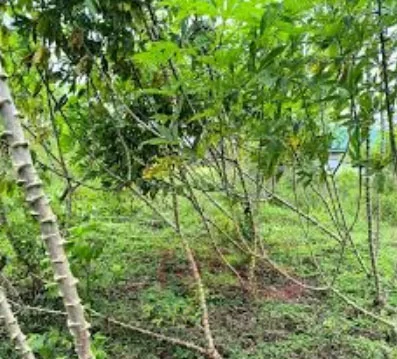
Suriname’s agricultural sector faces an escalating biosecurity emergency as an aggressive strain of Cassava Witches’ Broom Disease demonstrates accelerated proliferation beyond initial projections. The Center for Agricultural Research in Suriname (CELOS) has issued heightened alerts to farming communities following concerning reports from multiple districts, particularly Marowijne, where cassava plants exhibit severe pathological manifestations.
The pathogenic variant presents distinctive symptomatology including abnormal proliferation of branches, pronounced leaf deformities, and critically stunted growth patterns—rendering infected specimens entirely unsuitable for cultivation. CELOS Director Soedeshchand Jairam characterized the situation as epidemiologically urgent, emphasizing that “this disease manifestation represents a novel threat to Suriname’s ecosystem. Preventive inertia is not an option—our intervention velocity directly correlates with containment efficacy.”
While cassava phytopathological conditions have historical prevalence across South America, this emergent strain demonstrates significantly heightened virulence. Previously documented in Southeast Asia since 2010 with substantial agricultural devastation, the pathogen breached Western Hemisphere defenses through initial 2023-2024 detections in French Guiana. Jairam notes this established “immediate cross-border contamination risks that current observations confirm have materialized at our national perimeter.”
The disease transmission occurs primarily through human-mediated transportation of infected cassava cuttings, creating critical control challenges. CELOS advocates stringent phytosanitary protocols urging farmers to exclusively source planting materials from visually asymptomatic fields. The institution, supported by the International Center for Tropical Agriculture, is developing a national diagnostic certification system to validate planting material biosecurity.
Digital surveillance reports indicate concentrated symptomatic manifestations across eastern and southern regions, with additional suspected cases identified in Brokopondo and Saramacca—suggesting potential multi-regional dissemination. CELOS is coordinating comprehensive field inspections to delineate contamination boundaries and severity gradients.
Socioeconomic implications are substantial given cassava’s role as staple subsistence crop and primary income source for thousands of smallholder agriculturists. Pathogenic disruption of vegetative propagation mechanisms threatens direct production declines and severe livelihood impacts. Jairam emphasizes collaborative vigilance: “Farmers constitute our primary surveillance network—their observational acuity and willingness to report anomalies remain paramount to containment success.”
The director concluded that effective pathogen management requires integrated response frameworks: “This battle transcends institutional capabilities—it demands consolidated action across farming communities, civil society, and governmental agencies as shared biological security responsibility.”